We are struggling up the steep, uneven forest path, lit only by Agop’s handheld flashlight. In the darkness, two charcoals flash momentarily—the eyes of a deer. One by one, the forest’s twilight musicians awaken: The squeal of a rodent is followed by a hesitant cricket song. We also hear the distant call of an owl.
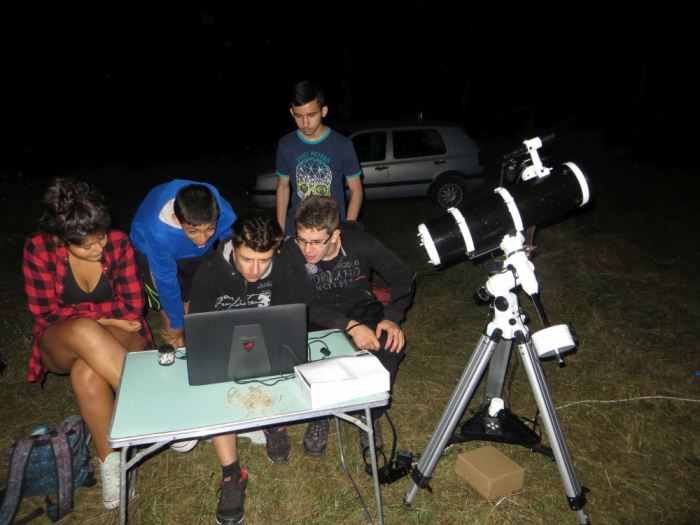 Suddenly, the darkness recedes, and we find ourselves in the middle of a vast clearing illuminated by thousands upon thousands of stars. A scene straight out of UFO Hunters slowly materializes in front of us: People wearing headband lights are milling around. We see small observation stations equipped with telescopes and laptops with their screen brightness set to low so as not to interfere with the observations. The conversations are quiet but persistent, lively. A cemented platform in one part of the clearing serves as a mini lab, its occupants directing telescopes, setting up cameras, and entering data into computers.
We are in the open observatory where, for several weeks each summer, students and lecturers from the Belite Brezi Astronomy Summer Camp explore cosmic objects and phenomena. For nearly half a century, the camp has attracted inquisitive high school and college students from all over Bulgaria, driven by their love of astronomy and their desire to deepen their knowledge in the field under the mentorship of recognized scholars and practitioners. During the day, participants attend lectures, while their evenings are reserved for sky exploration.
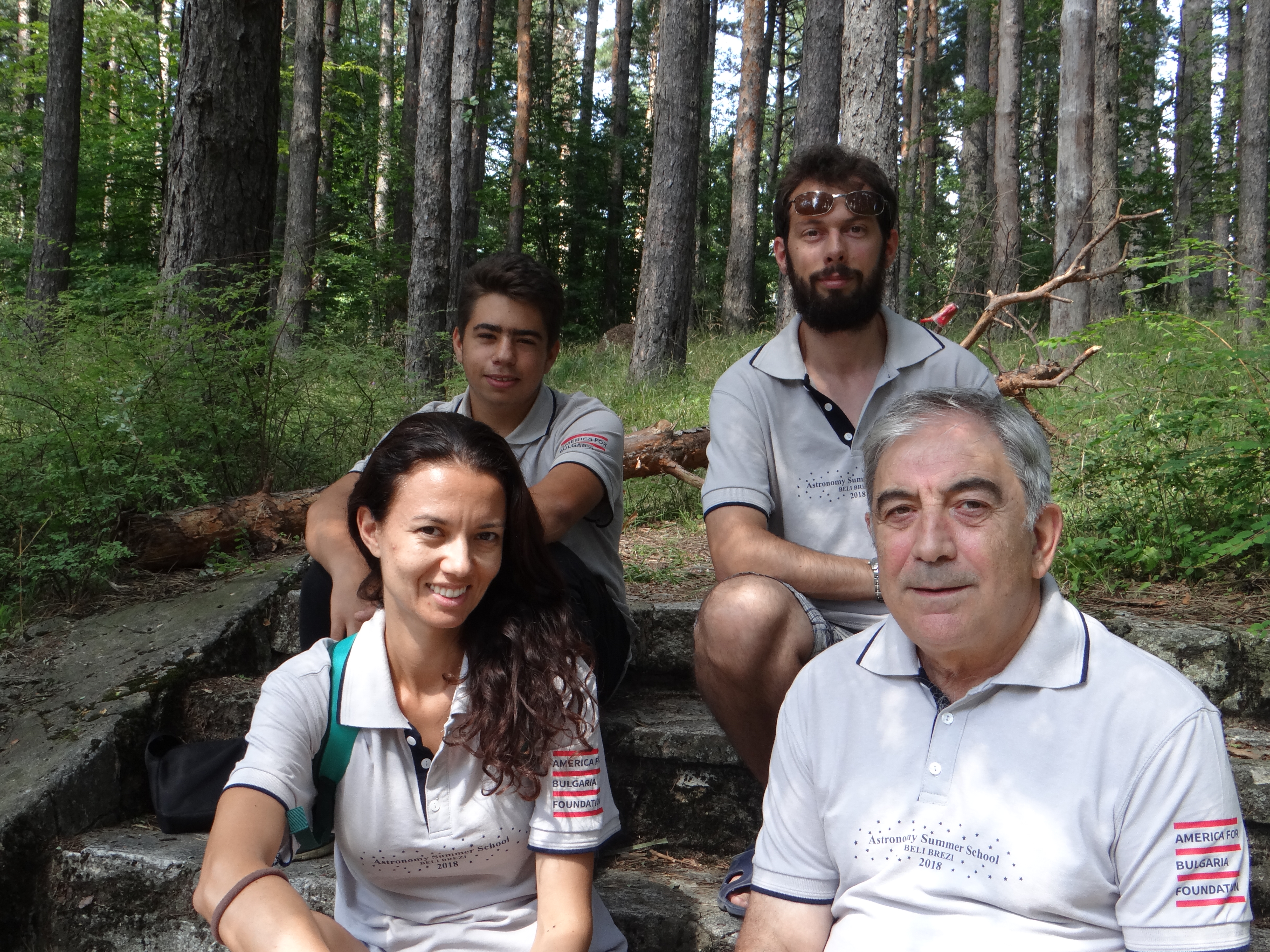
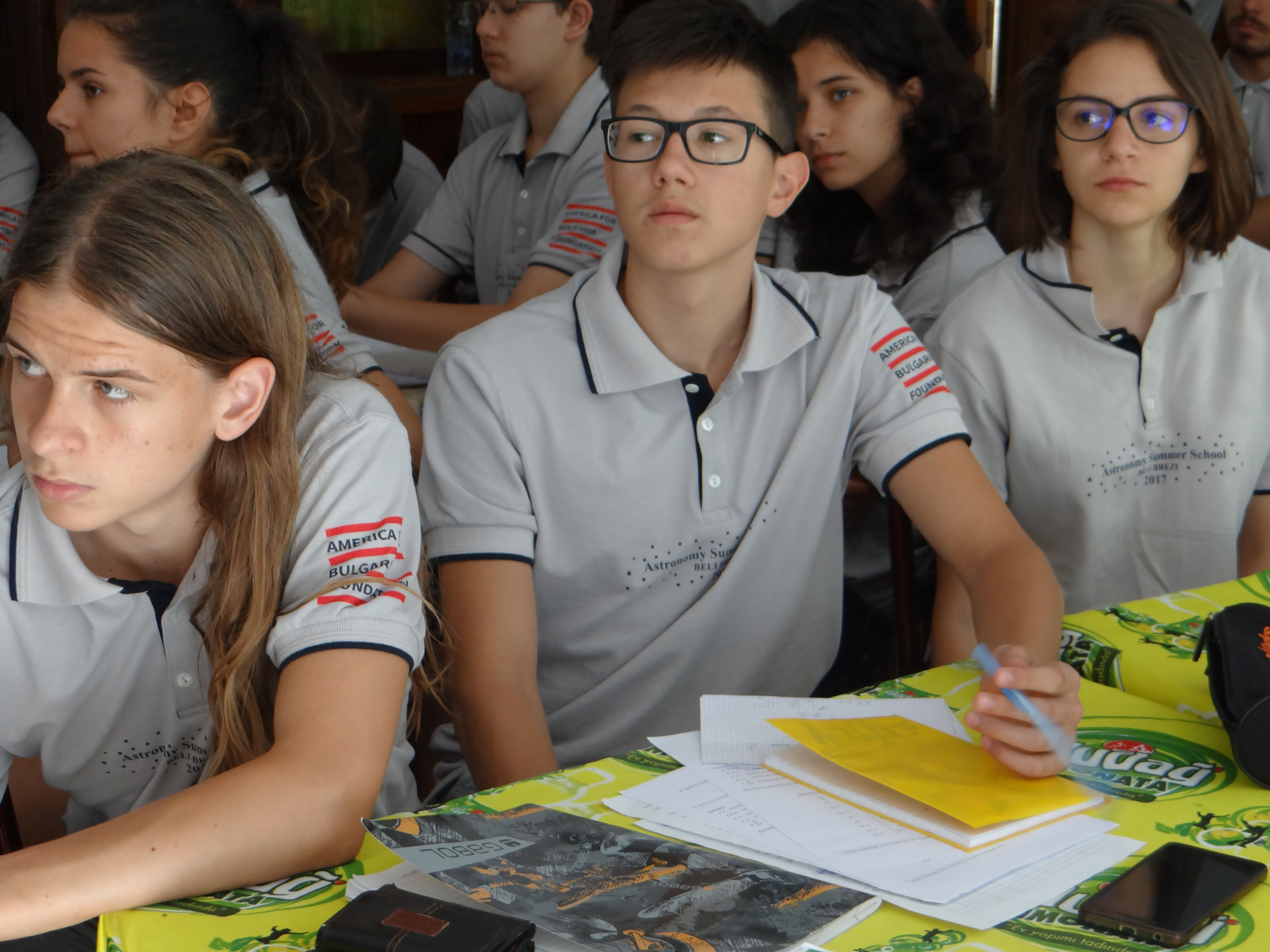 The astronomy camp has no paid staff, and its lecturers are volunteers. Its activities are supported by donors such as the America for Bulgaria Foundation. It has existed for nearly half of a century thanks to the enthusiasm and efforts of Agop Uzunbohossjan, the director of the Astronomical Observatory in Kardzhali, as well as dozens of alumni who come back from all over the world to teach and help the younger participants. Among the graduates and current lecturers are some of the most successful Bulgarian scientists—academics and researchers employed at such institutions as the Institute of Astronomy of the Bulgarian Academy of Sciences, the Massachusetts Institute of Technology, the Francis Crick Institute in London, the Max Planck Institute in Munich, Lowell Observatory in the United States (where the dwarf planet Pluto was discovered), Valparaiso University in Chile, and the European Northern Observatory in the Canary Islands. At the summer camp, however, everyone is equal, and teachers and students work side by side.
Deana Teneva, a third-year genetics student at the University of Aberdeen, in Scotland, is a bit of both. This is her eighth year at the camp. “As Agop says during orientation each year, the camp functions the way 19th-century Bulgarian schools did: older students help teach the younger ones,” Deana says. Albeit still a learner herself, she is responsible for the high school students in her group, who observe extrasolar planets, star clusters, and asteroids.
 Observations are carefully recorded, and the results analyzed, Deana explains. The findings are then presented at the annual National Astronomical Conference in Varna in the spring, and the data collected about asteroids, comets, stars, and other cosmic bodies has been the subject of a series of scientific papers over the years.
Milen Minev aims a green laser pointer in the direction of Mars, which is exceptionally bright and large. This is the closest the Red Planet has been to Earth since 2003. Milen, a regular participant since 2011, is a PhD student in astronomy and astrophysics at Sofia University and represents Bulgaria on the research team at the European Northern Observatory studying high-energy gamma rays. “I like spending two weeks in natural surroundings, observing all sorts of interesting objects in the most distant corners of the universe, and getting new knowledge and teaching it to younger students,” he says.
Professor Ilian Iliev of the Bulgarian Institute of Astronomy has dedicated 35 summers to the camp as participant, lecturer, and supervisor. “Why do I return? This is what ‘pay it forward’ means to me. It is also interesting, fun, and even a bit nostalgic in the last few years,” the professor says.
 Miroslav Ivanov is a biologist at the prestigious Francis Crick Institute in London, but he visits the camp for at least a few days every year to talk about the human body in space. “I keep returning mostly because of the sense of belonging,” Miroslav says.
The community feeling as well as a job at the Kardzhali Observatory is what made Agop stay. He first visited as a university student in 1970, the camp’s first year. Since then, Agop has missed just three summers—while he served in the military and when his daughter was born. For 25 years, Agop has been in charge of the camp, which involves fundraising, logistics, scheduling, mentoring, and day-to-day care for the participants. During the camp, he is both teacher and parent and can often be heard reminding the youngest participants to bring warm clothes for evening observation. He personally delivers a midnight snack to those camping out in the open with the equipment.
“It is important for someone to stay behind and continue what others started. My teachers did it for me. Now, it’s my turn to give back,” Agop says simply.
In the morning, when we say goodbye, the sense of community is so palpable it feels a lot like we are leaving behind people we’ve known for a long time. As we drive away, the deer darts away through the pine trees.
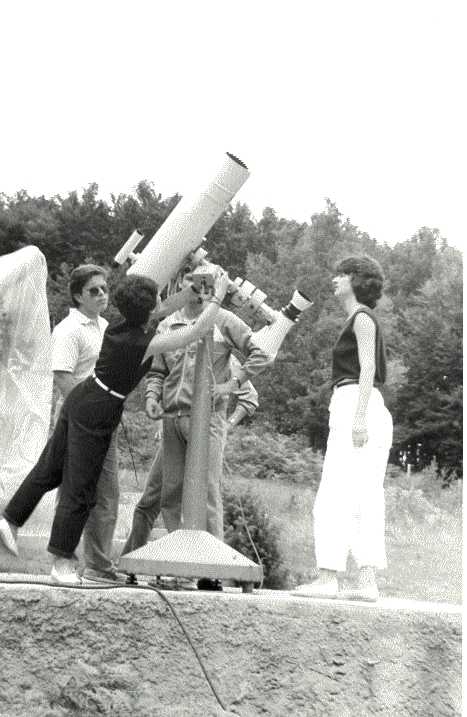
Photos: 1. Students explore the night sky; 2. Students attending an astrophysics class; 3. Natalia, Agop, Malin, and Milen; 4. One of the first astronomy camps in the 1970s