Listen to the story: 9:53 min
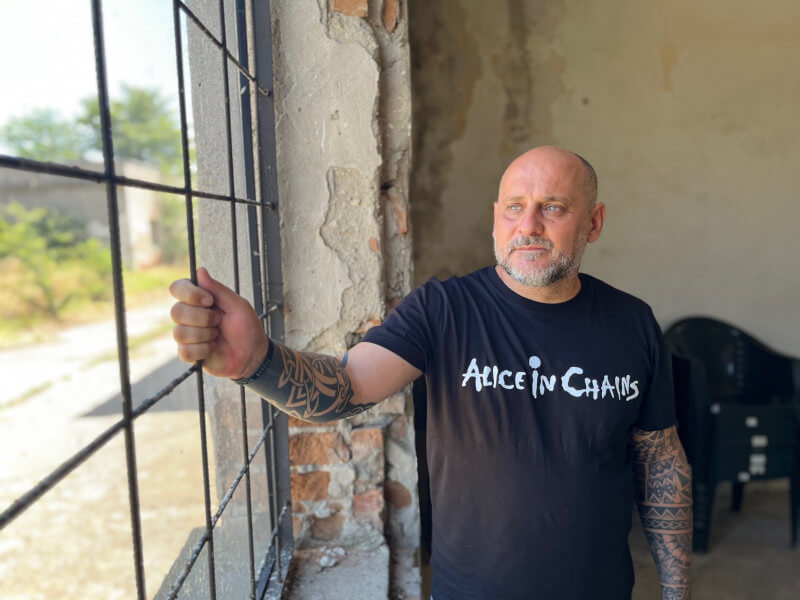
The first thing you’ll notice are his eyes—pale blue, almost translucent, cool as a Danube morning. His arms are covered in bold tribal tattoos, which he pairs in summer with T-shirts of his favorite metal or punk bands and in winter hides under a hoodie and camouflage jacket. If you saw him at dusk, walking down a quiet street, you might instinctively cross to the other side.
But that first impression vanishes the moment he says hello. His voice is soft and friendly, his smile boyish. Mihail jokes that, back in the 1950s, he would have been a prime target for the police—those who patrolled the streets chasing down young people for their “Western” clothes and hairstyles.
It’s the kind of joke that hints at the absurdity of those times, when even the cut of your jeans—or simply owning a pair—could land you in trouble. Under Bulgaria’s communist regime, it wasn’t just your words that were policed; your haircut, your record collection, your very appearance could mark you as an enemy.
Today, Mihail Marinov is the co-founder of the Belene Island Foundation and one of the few locals fully dedicated to preserving the memory of nearly 20,000 people who were sent—without trial or sentence—to Bulgaria’s largest and longest-running communist-era concentration camp: the Belene labor camp, which operated from 1949 to 1987.
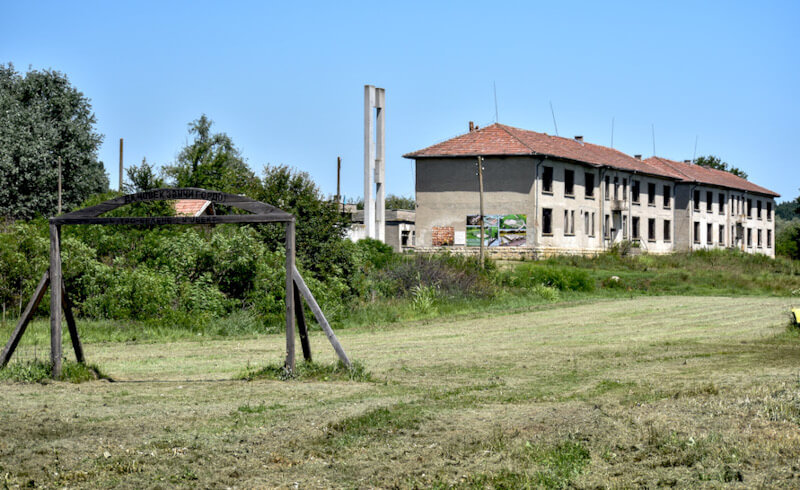
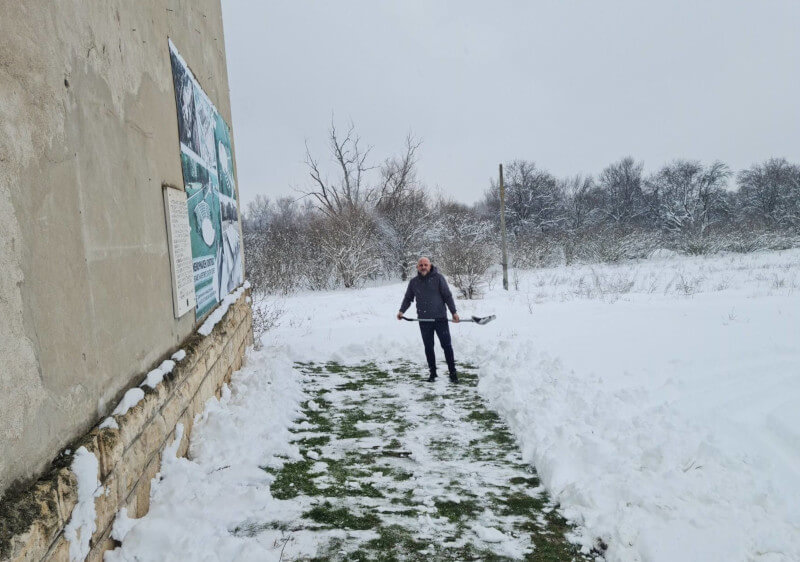
If you’ve visited Belene recently, chances are Mihail was the one who guided you to the island and the remnants of the former camp. And even if someone else led your tour, you’ve still seen his work: cleared paths, tamed overgrowth, repaired roofs, and locked doors and windows protecting the ruins from animals and poachers.
A winding path—and a return
Mihail’s first visit to Belene Island—also known as Persin Island, famed for its thick vegetation and wildlife—was completely innocent. As a child, he tagged along with family friends for a weekend at a police-owned villa there. For most Belene residents, though, the island was off-limits. To them, it was just a patch of wilderness in the middle of the Danube. People whispered vaguely about a prison for criminals, but no one dared mention the camp itself.
Mihail grew up in a Catholic family, always with his nose in a book—history, science fiction, anything he could get his hands on. Reading became a window to worlds far beyond the flatlands by the river.
After middle school, the practical choice was the local nuclear technology high school, built near the unfinished nuclear power plant, where he studied nuclear electronics. He went on to attend the Ruse Technical University, but the subject didn’t hold his interest. He completed his mandatory military service at an airbase guarding the skies over Kozloduy during the chaotic years of hyperinflation, when wages vanished before you could even reach the store. Later, he studied economics in Svishtov, worked in England, then moved between apartments in Sofia. Despite all the places he’d been, something always seemed missing—perhaps a place to call home.
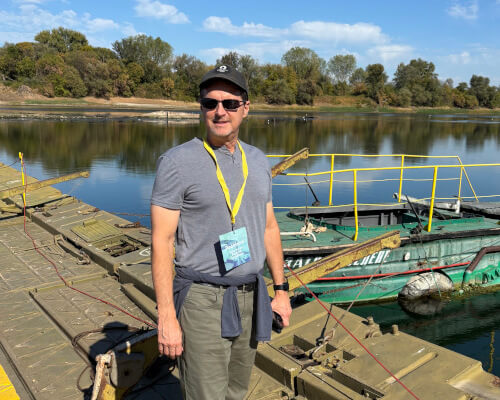
In 2012, shortly after settling back in Belene for good, Mihail met Father Paolo Cortese, an Italian priest serving the local Catholic community, which makes up the majority of the town’s population. The priest had already dug into the camp’s archives and was searching for a local partner to help him on the ground. Nearly every week, the two crossed the pontoon bridge to Persin Island armed with shears, trimmers, and trash bags, spending hours clearing the overgrown path to Site 2—the main section of the former camp. When the machines fell silent, they would sit and plan their next steps: how to make the ruins more accessible to visitors. Soon after their first serious cleanups, they began leading guided tours.
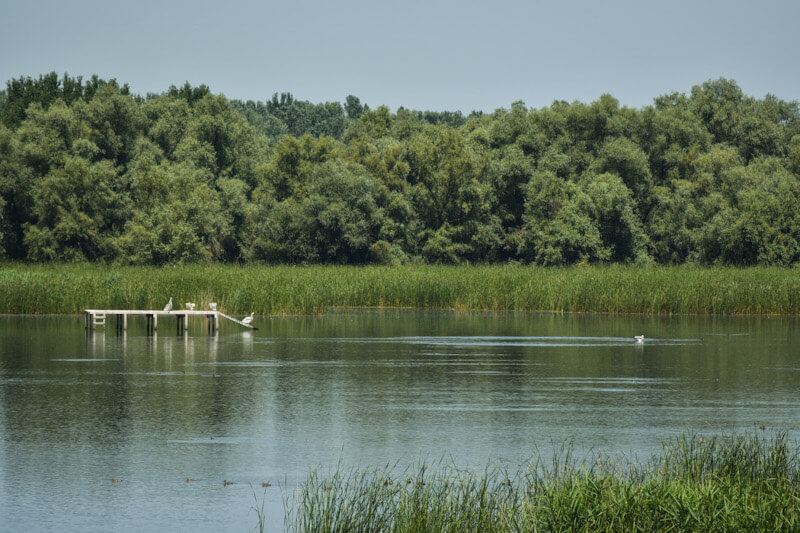
The island’s dark past, once only whispered about, started to be spoken aloud.
“It took a foreigner to open my eyes to the history of the Belene camp,” Mihail says, still amazed that it took an outsider to help him see his own homeland differently.
Italy answers the call
The first to answer the call for large-scale cleanup efforts were, once again, mostly foreigners. In the summer of 2013, Father Cortese brought nearly fifty Italians to help. They were joined by five Bulgarians from other parts of the country—and only a handful of locals from Belene itself. For Mihail, this was a sobering realization: the task was enormous, and few Bulgarians saw it as their responsibility.
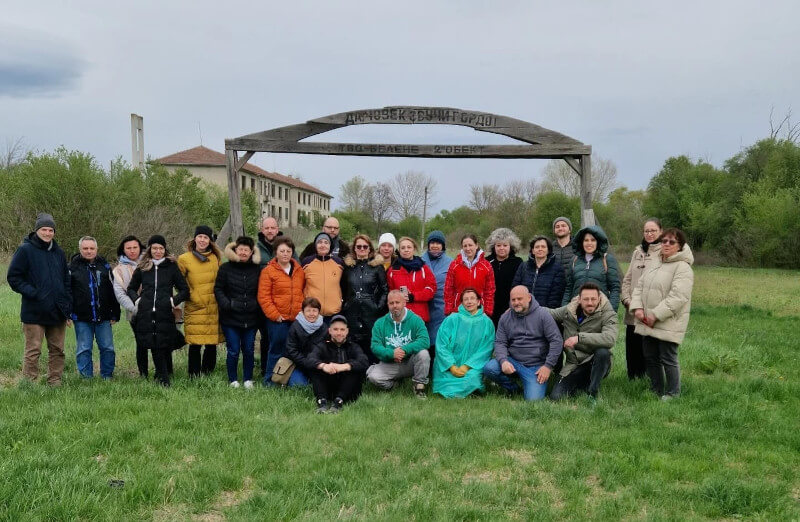
From then on, his shelves of science fiction gradually gave way to memoirs, archival documents, and research about the Belene camp. His free time became a balance of reading and physical work on the island. Volunteers with hedge trimmers and shovels cleared the thick brush around Site 2, hauled away nearly a meter of accumulated dirt and debris, stabilized crumbling chimneys, patched roofs. A symbolic milestone came when they restored the camp’s entrance gate—bearing the bitterly ironic slogan, “To be human, how proud it sounds!”
The more they cleared, the more the past revealed itself: a concrete washbasin, the foundations of the first barracks, a name tag belonging to a prisoner whose fate remains unknown. “Wherever we dig, we find a piece of the camp’s history,” Mihail says.
Breathing new life into Site 2
In 2013, only about sixty people visited the island. Today, thousands come each year—families, students, researchers, and occasionally even survivors. July and August are too hot for most visitors, but once the September breeze returns, the tour schedule quickly fills up again.
The hardest visits, Mihail says, are the ones with former prisoners. They move slowly, their fingers tracing the peeling walls, pausing to listen to the wind. Eventually, they retreat to a small prayer room that Mihail and Father Cortese created at their request—simple white walls, a few benches, quiet. “Those silent moments,” Mihail notes, “speak the loudest.”
Bit by bit, in partnership with researchers and other organizations, the once-empty halls of Site 2 have filled with stories. Outside, a display shares personal accounts from former prisoners. Inside, two larger exhibits bring the past to life. Cracks in the Wall showcases secret portraits sketched by military prosecutor and former camp inmate Petar Baychev, smuggled out when he was released in 1954. The newest exhibit, developed by Sofia Platform and The Convo, spans two floors and traces the various waves of repression—from the first detainees in 1949, through the “hooligan” arrests of the ’50s and ’60s, to the brutal campaign against Bulgaria’s Turkish and Muslim populations in the 1980s.
What was once just a ruin has become a living narrative—a place where every wall whispers the lives of those who weren’t allowed to speak.
The long road to a memorial
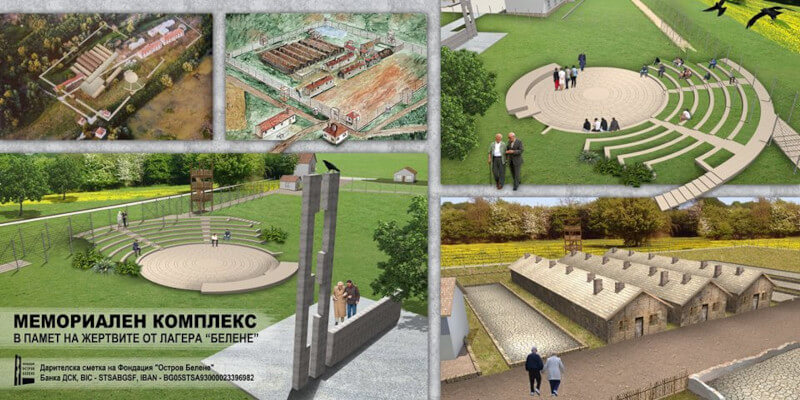
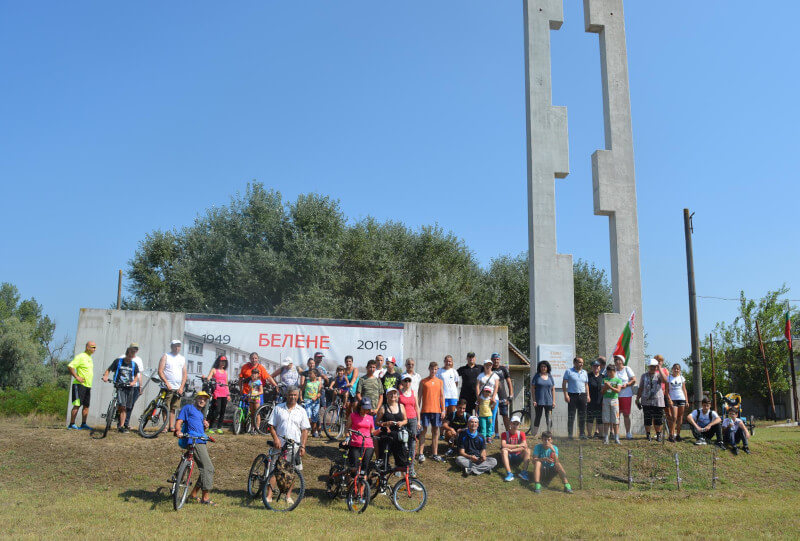
In 2016, Mihail and Father Cortese officially established the Belene Island Foundation, determined to carry the story beyond the banks of the Danube. Since then, traveling exhibitions have crossed Europe and the US: stories of musicians persecuted by the regime; a model for a future island memorial shown in the European Parliament and at the Bulgarian community center in Chicago; photos and personal testimonies displayed in the lobby of Bulgaria’s National Assembly; an interactive exhibit in Washington, where visitors could “speak” with Belene survivors through virtual interviews.
Awareness keeps growing, but Mihail’s dream remains unfinished: a permanent memorial for the victims of communism, not just on paper or canvas, but built right alongside the ruins themselves. That dream still awaits political will—and steady funding.
“Our camp”
For Mihail, Site 2 has long since become “our camp”—a cause that shapes his daily life. When architects Alexander Genchev and Iglika Lyutskanova drafted a design for a memorial between 2012 and 2015, he was convinced it would be built within five years. But time has taught him just how many hurdles stand in the way. Thirteen years later, the museum remains on the drawing board—but Mihail’s resolve hasn’t wavered.
“This was the biggest camp for terror, torture, and murder—we have to preserve it, so history doesn’t repeat itself,” he says. He describes himself as “stubborn—but not like an Aries, more like an Aquarius,” meaning persistent yet fluid, like water finding its way around every obstacle.
When the Bulgarian Helsinki Committee presented him with their “Guardian of Memory” award, Mihail accepted it not as personal recognition but as a tribute to everyone who refuses to let this history be forgotten.
Standing by the banks of the Danube, where the river gently laps at the sandy shore, Mihail pauses for a moment. The silhouette of Belene Island rises in the distance—a silent witness to a past he won’t stop speaking about. With a quiet nod toward the water, he says simply, “The work doesn’t weigh on me. It gives me meaning.”