Listen to the story: 12:48 min
The language of the hive
The first sign that something is wrong isn’t silence.
It’s sound.
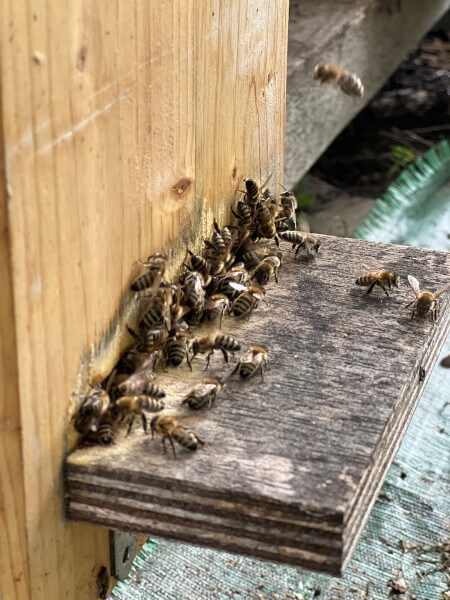
Bees buzz constantly, but not always in the same way. To an experienced beekeeper, that hum isn’t background noise; it’s information. From sound alone, they can tell whether a colony is calm, under stress, or on the verge of change. This knowledge isn’t learned from a book. It comes with years of work: observation, mistakes, seasons that teach patience the hard way.
The problem isn’t that beekeepers can’t “hear” their bees. The problem is scale. When you manage dozens, sometimes hundreds of hives, you can’t be everywhere at once. You can’t open every hive at the right moment without disturbing the colony. And sometimes the right moment is today—not next week.
Sound, however, is only part of the message.
Every day, bees travel miles from the hive, collecting pollen from everything growing nearby and carrying it home. That pollen holds a record: of plants, of landscapes, of pollution levels, of climate shifts. Read correctly, it tells you much more than whether there will be honey this year. It tells you what enters our food system and what kind of food will be on our tables tomorrow.
A significant share of what we eat depends on how well we understand bees.
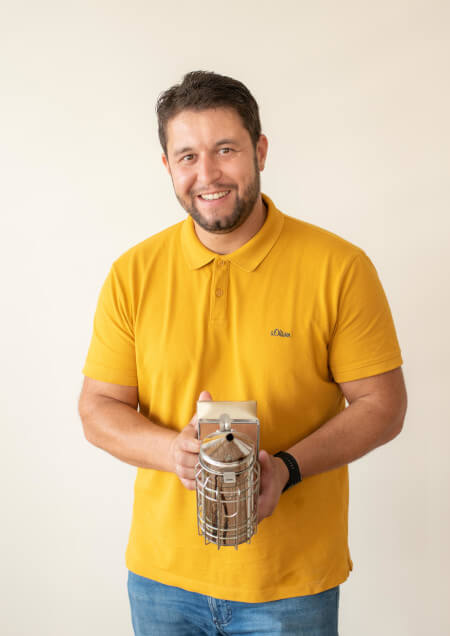
That is precisely what Sergey Petrov is trying to do. He develops technology that translates signals from the hive—sound, activity, collected pollen—into information humans can act on. Not to replace the beekeeper, but to extend their senses; to make it possible to hear the bees in time, even when the hives number in the hundreds.
Think of it as an engineer’s dictionary: a way of translating the language of the hive into human terms, in service of beekeepers, food systems, and everyone who depends on them.
A question for one billion people
At one point, Sergey found himself facing a question that sounded almost absurdly ambitious:
How can a single idea improve the lives of more than one billion people?
It wasn’t rhetorical. It was a requirement for applying to Singularity University (now Singularity), a US-based program supported by Google and NASA that brings together people from around the world to tackle large, systemic challenges—problems that shape the future far beyond the lifespan of a single product or company.
Sergey’s path there only makes sense in hindsight.
He studied aeronautical engineering at the Technical University of Sofia, fully intending to become a pilot. He liked discipline, systems, and the idea that every decision carries consequences. But meeting Raycho Raychev, founder of the Bulgarian satellite company EnduroSat, shifted his focus. Raychev became his mentor and later his business partner; he drew Sergey into the Space Challenges program and showed him that engineering thinking could be applied not just to machines, but to problems that affect all of us.
Raychev was also the one who encouraged him to apply to Singularity. To think bigger.
When Sergey began searching for his “one-billion-people” idea, he didn’t look to space, despite the context. He looked down: to the ground, to food, to the systems we take for granted. At the time, bee populations around the world were declining. Quietly. Gradually. With growing frequency. And without bees, the global food system begins to fracture.
“How can we send a person to the Moon and still fail to solve the problem of bees dying out?” Sergey asks.
There’s no grandstanding in the question. Just genuine bafflement, and a kind of engineer’s irritation.
That’s how the idea of the smart hive emerged. Not as another technological novelty, but as an attempt to listen more closely to what was already happening. To catch early signals. To allow intervention before problems become irreversible. For Sergey, this wasn’t a departure from high-tech work; it was its most meaningful application.
After Singularity, the direction was clear. Bees weren’t a side interest. They were an entry point into a much larger conversation about food, the environment, and how we choose to live.
When an idea runs ahead of its time
What followed were years familiar to anyone who has built a startup: intense work, high expectations, and no shortage of disappointment. Sergey and his team developed smart technologies for beekeeping, focusing primarily on the US market. They built prototypes, worked with partners, and searched for a way to bridge the gap between innovation and the people who needed it most.
What became clear was uncomfortable. The larger industrial agriculture grows, the harder it becomes for bees. Vast monocultures offer poor forage; pressure for higher yields leaves little room for error; response time shrinks. Technology can support beekeepers, but it cannot compensate for an environment that works against the bees themselves.
The product never reached mass adoption. Not because it failed, but because the timing, and the ecosystem around it, were wrong.
The lesson was difficult but unmistakable: if you want to help bees, you first have to help the people who take care of them.
That realization shifted Sergey’s focus. The question was no longer how to make the hive smarter, but how to make beekeeping sustainable.
And the answer, it turned out, wasn’t across the ocean. It was much closer to home.
Beekeeping as a reality check
In the meantime, Sergey started keeping bees himself, in a backyard in Orlandovtsi, a neighborhood in Sofia. Not for prestige. Not for romance. For testing. To stop speaking in theory. To experience what a bad season feels like, what a missed intervention costs, what it means when a colony doesn’t survive.
That firsthand encounter grounded him. It shifted his focus from what technology can we build to what problem are we actually solving. By 2019, with his company on the brink, the choice was clear: it was time for a reset, closer to home and closer to people.
Real Honey and the rebuilding of trust
Real Honey (“Istinski med” in Bulgarian) did not begin as a brand with a sweeping vision. It emerged as a response to a concrete, painful problem.
Bulgarian beekeepers were working on the edge of survival. Purchase prices were low, their labor undervalued, and the market flooded with fake honey. Consumers, meanwhile, had little trust in what they were buying—and often for good reason.
The solution was radically simple: remove the middlemen and restore the connection between the person who produces the honey and the person who eats it. Every jar on the Real Honey platform comes with laboratory analysis, clear origin, and a real person behind it. If someone has doubts, they can go and see for themselves. Stand next to the hive. Talk to the beekeeper.
Nearly 300 families did exactly that in the first year.
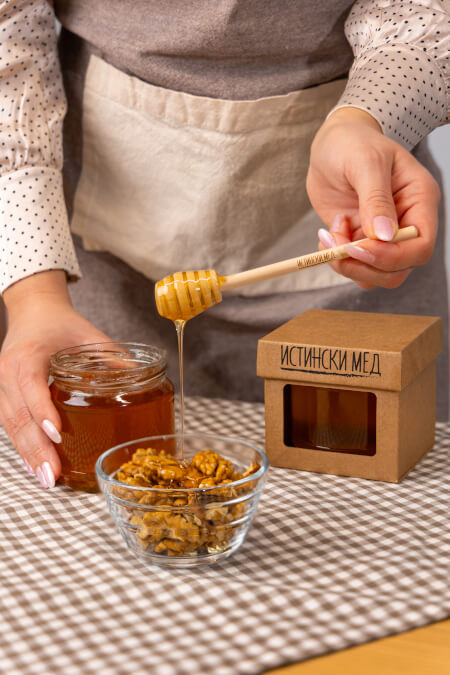
From there, the model began to grow on its own. The “Adopt a Hive” campaign gave beekeepers something rare in their profession: predictability. On the other side, it gave people the sense that they were part of the process, not just customers.
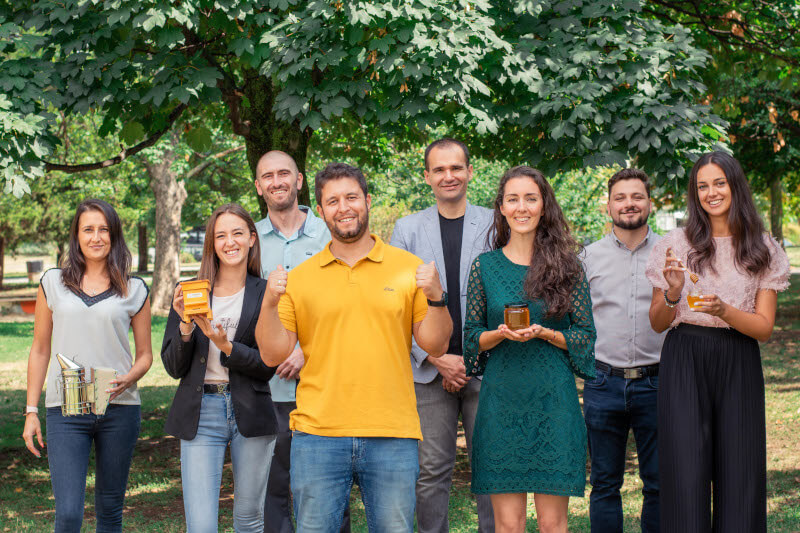
Today, Real Honey operates in Bulgaria, Romania, and the Czech Republic. The team includes 13 people, works with 68 beekeepers—50 of them in Bulgaria—and supports nearly 6,000 adopted hives through families and companies.
But trust is not built by a platform alone.
Everyone on the Real Honey team has experienced beekeeping firsthand, even if they don’t own hives themselves. The people running the platform know what the work looks like on the ground and what a single mistake can cost. Through the Real Honey Foundation, the team also runs educational programs on the role of bees in life on Earth. Sergey and other beekeepers visit kindergartens, schools, and companies; they talk, demonstrate, and answer questions.
Sometimes these meetings end with sticky fingers. Sometimes with silence, when people realize how much depends on something so small. And sometimes with team-building sessions in which bees turn out to be remarkably precise teachers of collaboration: no hierarchy, no unnecessary noise, clearly defined roles.
This is how Real Honey becomes more than a marketplace. It becomes a community, and a slow but durable way of rebuilding trust: trust in food, in the people behind it, and in systems we rarely see but rely on every day.
Growing without losing direction
Even as Real Honey gains stability, Sergey continues to look for ways to improve the lives of bees and, through them, people. Some of this work is visible. Some unfolds quietly, within international scientific and technological partnerships.
One of them is Hiveopolis, a research project with an ambitious goal: to create a contemporary smart hive adapted to today’s challenges, from pesticides and parasites to climate change and urban environments. The project brings together scientists, engineers, and beekeepers from across Europe around a shared belief that the future of beekeeping depends on cooperation—between people, technologies, and bees themselves.
In Hiveopolis, the hive is no longer just a box. It becomes a system in which sensors, intelligent materials, and even small robots help colonies navigate their environment more effectively: avoiding dangerous food sources, preparing for harsh weather, distributing effort more efficiently. The results, published in 2024, are part of a broader conversation about how science can support biodiversity without subordinating it.
For Sergey, this work is not a detour. It is a natural continuation. It aligns with his commitment to learning, building, and remaining open to new ideas and partnerships.
That same search for clarity led him, in 2025, to apply to the LEAP leadership program of the America for Bulgaria Foundation. Not for titles, but for perspective. How to grow a company without exhausting the team. How to scale without losing meaning.
LEAP gave him space to rethink his role as a leader and return to what matters most. For Sergey, the team comes first. Not as a slogan, but as a daily choice.
From that point on, his work with beekeepers, his research partnerships, and his role as a leader begin to inform one another in concrete ways—through decisions made on the ground, not statements of intent.
Thinking about tomorrow while working today
“I want it to be prestigious to be a beekeeper in ten years,” Sergey says. He doesn’t frame it as a dream, but as a direction, something achievable through sustained, consistent effort.
Today, that effort is no longer only personal. The company behind Sergey’s technological work is now public and attracting investor interest, a sign that caring for bees and biodiversity is beginning to be recognized not merely as a good cause, but as a meaningful and sustainable path forward. Quietly. Patiently. Much like the bees themselves.
At the same time, the team continues to develop hive digitalization with funding from the European Union. With support from the America for Bulgaria Foundation’s Science with a Future program, they are also studying biodiversity and pollution in Bulgaria, using bees as biosensors. The first results will be shared soon—not as a verdict, but as an invitation to look more carefully at the environment in which we live and produce our food.
Soon, Sergey and the team will open a Bee Museum. Envisioned as a meeting place between science and practice, between children and beekeepers, between curiosity and responsibility, it is meant to prompt a simple but unsettling question: why does all of this matter?
The story of Sergey Petrov is not a story about bees.
It is a story about choosing to listen, early and attentively. About recognizing signals before they become crises. About connecting people, technology, and nature instead of setting them against one another.
And the bees?
They have always been there. Working. Quiet. Persistent.
Waiting for more people to start listening.