If you ever find yourself in a small Bulgarian village where people are cooking for 70 guests—though you said you’d be bringing 10—there’s a good chance Stefan Bozadzhiev is nearby. Because when Stefan takes travelers—most often Americans—into the farthest corners of Bulgaria, the locals don’t treat him like a tour operator. They welcome him as one of their own. Someone who respects them. Someone who comes back. And gives back.
Beyond the guidebook
Stefan believes in “tourism that gives back.” Not just in the emotional sense—though there’s plenty of emotion in his tours—but literally. The groups he leads support community centers, schools, local artisans, and volunteer performers. In the town of Dupnitsa, for example, he’s worked for years with one of the active local schools. Thanks to donations from colleagues and guests, outstanding students from low-income families get to experience the arts: trips to the opera, walking tours in Sofia, meetings with inspiring people. “We want to show them there’s another world out there,” he says.
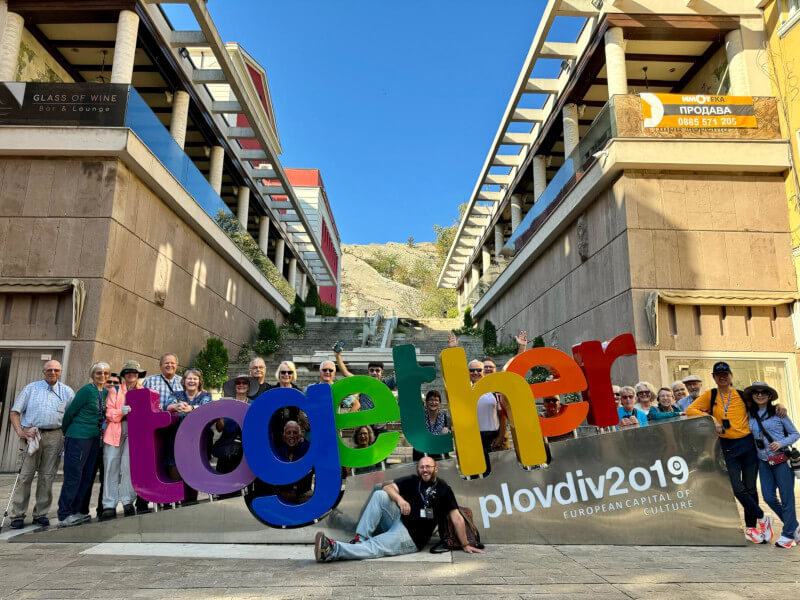
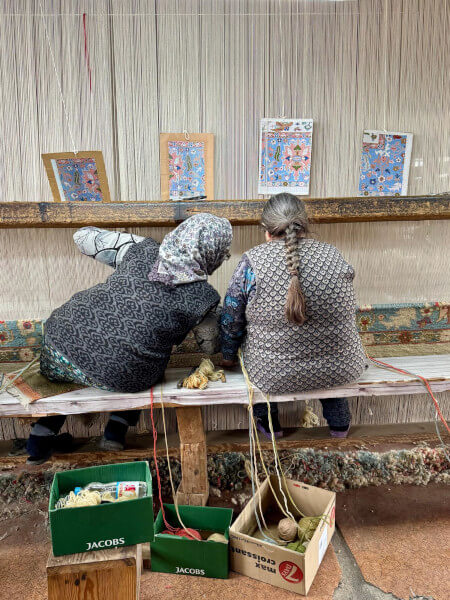
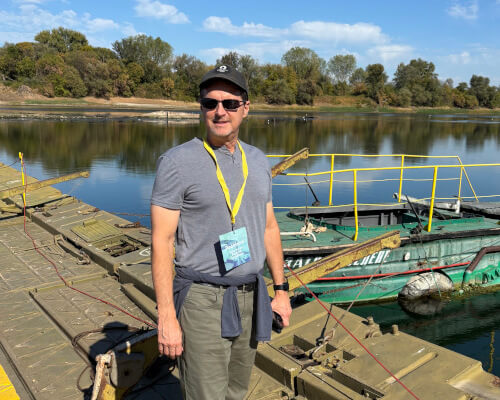
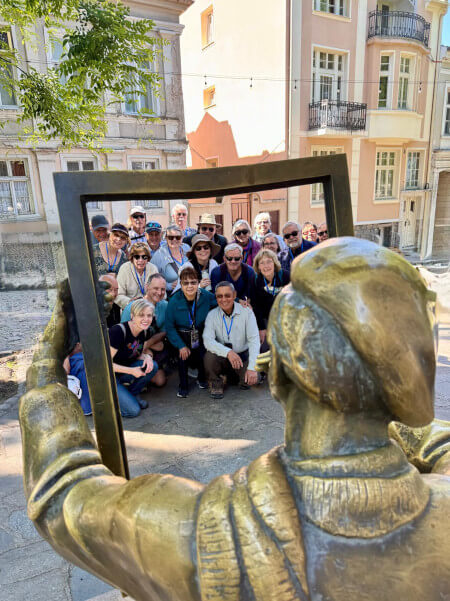
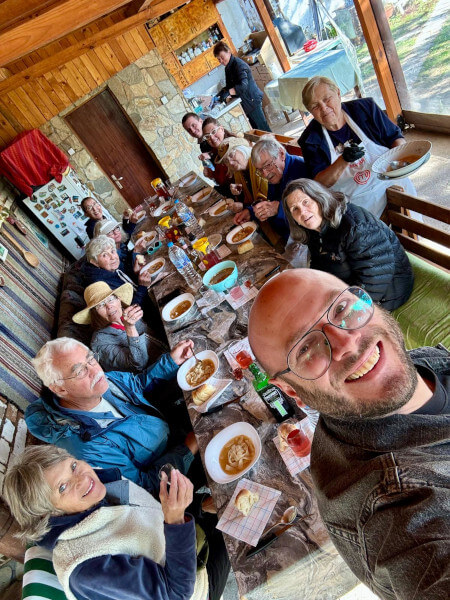
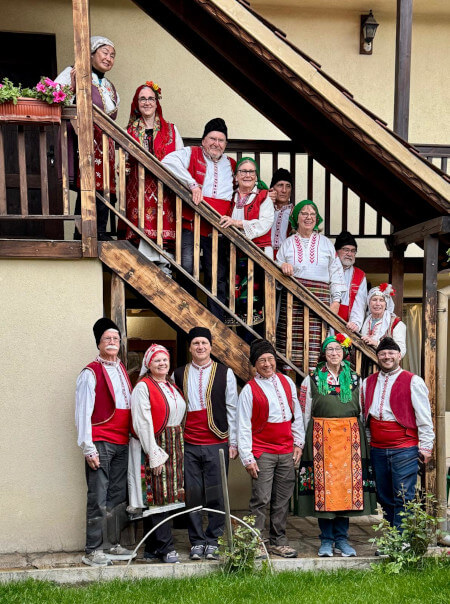
His travelers—most of them Americans over 55 who have been all over the world—don’t just take photos of façades. They knead trahana dough in Yakoruda, in southwestern Bulgaria; listen to Banat Bulgarian songs in the village of Assenovo, near the Danube; and meet economists, craftspeople, and community organizers. This May, Stefan is leading a group whose itinerary includes not just the major tourist sights, but also a talk on Bulgaria’s current economic and social context, visits to schools, workshops, craft markets, and dinners with people who keep local traditions alive.
“It’s not about the place. It’s about the experience,” Stefan says. And if there’s one thing his guests remember, it’s not how tall that cathedral was or when that bridge was built. It’s the feeling. The encounter. The tears in a storyteller’s eyes. The laughter of the local choir members. Or just a smile that melts the initial awkwardness.
The beginning – one improvised answer, like-minded souls, and a lifelong love
“My first tour was at 16,” Stefan recalls. “A summer job in Kazanlak, guiding visitors through the Thracian tomb. A tourist asked me something about the structure. I didn’t know the answer, so I made it up—said the opening in the dome was where the souls of the dead would rise… and honestly, I wasn’t far off! They loved it. And I told myself, Stefan, you’ve got a lot to learn.”
And that’s exactly what he’s been doing ever since. Because for Stefan, guiding isn’t about reciting a prepared script. It’s a living art—the art of reading the person in front of you, listening closely, and speaking their language. Sometimes in one sentence. Sometimes in a hundred. His legal training at Sofia University helps. Though he never practiced law, the logical thinking, the structure, the ability to read between the lines—all of it comes in handy when he’s explaining what it means to be Bulgarian to someone who’s never been here before.
That dedication to storytelling and human connection found its home at Lyuba Tours, the company Stefan has worked with his entire career. Founded in 1990 by Lyuba and Yuri Boyanin—engineers by education, dreamers by nature—it was one of the first travel companies to emerge in post-communist Bulgaria. With little tourism experience but a big heart for their country and its people, the founders set out to show Bulgaria in a way no one had before: layered, complex, deeply human. After Lyuba passed away in 2016, her son Yuri and Stefan took the reins. Together, they’ve carried on her mission—with attention to detail, love for people, and a belief in the kind of tourism that goes far beyond scenery. Tourism that creates connection. Tourism that leaves a mark.
“Why Bulgaria?”
It’s the first question Stefan asks every group. The answers are often vague: “Why not?” “A friend recommended it.” “We’ve seen all of Europe—except this part.” But by the end of the trip, the response is very different: “Now we understand.”
Because Bulgaria is a country of many faces packed into a small space. A crossroads between East and West, Christianity and Islam, land and sea.
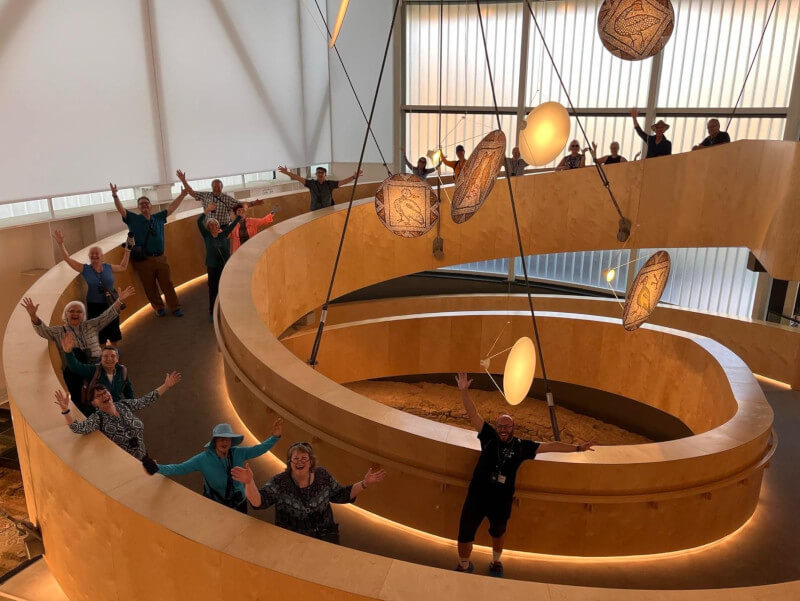
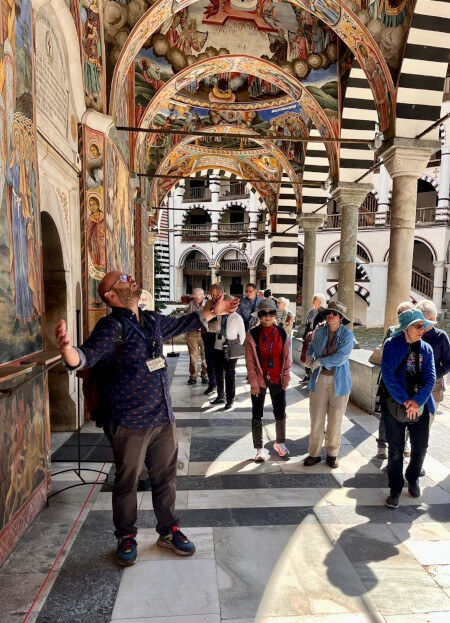
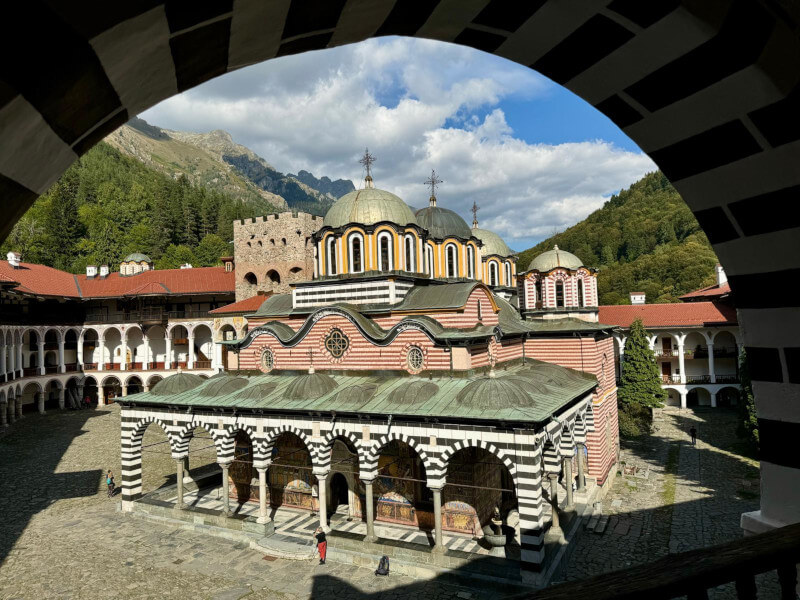
At Rila Monastery, guests are captivated by the frescoes—especially the demons, which they don’t expect. In Plovdiv, the Bishop’s Basilica of ancient Philippopolis leaves them speechless—not just for its mosaics, but because they can literally walk on history. And when Stefan shares the story of how Bulgaria, an ally of Nazi Germany, saved its Jewish population from deportation and death during World War II, a hush falls over the group. Only the story speaks. “It’s important that good people don’t stay silent,” Stefan says.
And maybe that’s the key. Between the “must-see” landmarks, in the villages and roadside stops, something happens that no travel video can show: women bringing enough food for an army, men pulling out homemade rakia without being asked, children singing without being told to. Bulgarians often give more of themselves than anyone expects—because doing otherwise would be… embarrassing.
“We don’t want to embarrass ourselves in front of the foreigners,” Stefan says with a smile. “We say it jokingly, but it really speaks to who we are.”
Tourism that does no harm
For Stefan, this isn’t a slogan—it’s a guiding principle. There are places he doesn’t advertise. Villages he visits only with individual travelers. “Some places need to be protected—even from tourism,” he says. For him, sustainability isn’t a trend. It’s a responsibility. Sustainable tourism means respect—for people, for places. It means listening before promising change. It means not looking down from above.
Tourism isn’t just economics. Sometimes it’s an act of solidarity. Sometimes it’s a political act—as his favorite writer and frequent collaborator Rick Steves describes it. An act of understanding. An act of encounter.
Living heritage
In the winter months, when there are no tours, Stefan dives into the archives of his hometown, Kazanlak. Not to study roses or Thracians—but to uncover the town’s many faces. A city of textiles, aviation, art, industry, and music. (For over a century, “Kremona Kazanlak” has crafted guitars and stringed instruments whose music is heard around the globe.) A place too layered to sum up in a postcard.
In parallel, he collects 19th-century silver filigree. Someday, he plans to exhibit it. “I’ll enjoy it for a few years,” he says, “then let everyone else enjoy it too.”
But Stefan doesn’t live in the past. He’s also a voice in Bulgaria’s present—speaking up on social issues, supporting causes, defending communities and institutions. He’s active on social media too—clear, engaged, committed. “If I don’t speak up, someone else will—and I might not agree with them,” he says. For him, that, too, is a responsibility. As he often says: “It’s important that good people don’t stay silent.”
“One person meeting another”
That’s how Stefan describes his approach to tourism. “Community-centered. Culture-centered. Human-centered.” It’s not the quickest or easiest route. But it’s the one worth taking.
And if you ever find yourself on a narrow path, hearing a group of travelers pause in reverence before a master craftsperson, or listening breathlessly to a song—or to a story about how ordinary people stood up to extraordinary evil—chances are you’ve just stumbled into a tour led by Stefan Bozadzhiev.
And you’re about to discover why Bulgaria.