Listen to the story: 8:43 min
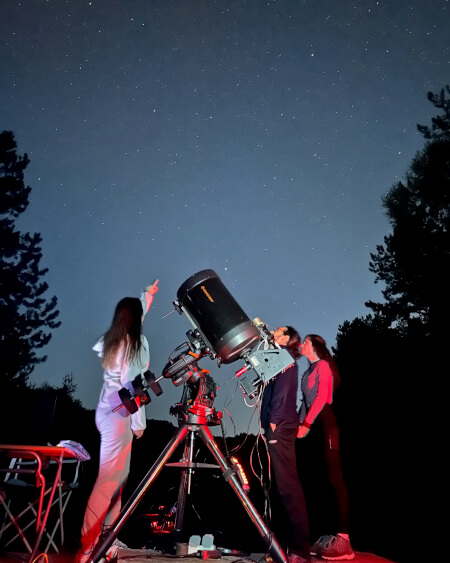
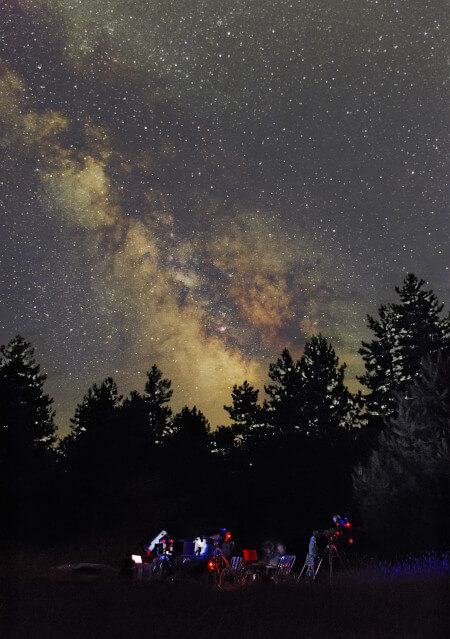
The path through the birch grove is dark and uneven, the air cool with the scent of tree sap and grass. Somewhere in the shadows, a twig snaps. A lone cricket starts up, quickly joined by a chorus of dozens more. An owl calls in the distance.
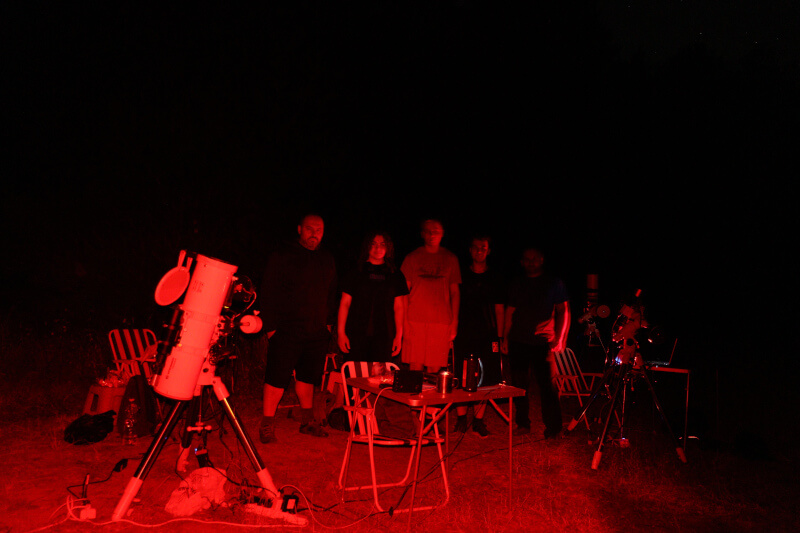
Then the trees fall away, and you step into an open meadow. The darkness here is softer, full of stars. Red headlamp beams flicker like fireflies between telescopes, cables, and laptops with their screens dimmed for night work. Someone counts quietly. Another tweaks a lens. A third taps a friend on the shoulder—“Got it!”
Welcome to Belite Brezi (“The White Birches”), a summer astronomy and astrophysics school named after this part of the Rhodope Mountains, where old birch trees still stand tall. For 55 years, it has been a launchpad for young people fascinated by the night sky. Many of its alumni now work on NASA and European Space Agency missions, conduct research at the European Organization for Nuclear Research (CERN), discover new planets, or win major science awards. But beyond achievements, the school is about community—friendships built under the stars, traditions passed down, and a shared pull that brings people back year after year.
Shared orbit: how a community forms
On the first night of the school, as the air still holds the warmth of the day, newcomers step carefully among the rows of telescopes. This meadow becomes an open-air observatory, a place where astronomy comes alive under the first bright stars.
Among those looking up is software engineer Alexandra Georgieva with her group of seven students. They’re watching a meteor shower—no telescope needed, just their eyes and notebooks to record each streak of light. “It’s such a thrill when a bright meteor flashes past—it sparks curiosity!” she says, smiling as one boy shouts that he’s just seen the brightest shooting star of his life.
Alexandra’s first summer here was in 2004, invited by the school’s director, Agop Uzunbohossian. That was the start of a journey that led to the California Institute of Technology, black hole research, and work with the LIGO gravitational wave detector. Today, even though her career is in software, late July and early August still find her back in the Rhodopes. “Belonging to a community that’s been going for so long—that’s why I keep coming back,” she says.
Agop himself is the school’s anchor. He attended the very first edition in 1970 and has missed almost none since. For decades, he’s kept the thread between generations: securing funding, arranging logistics, leading night observations, reminding the youngest to wear jackets, and making sure there’s hot tea and a “midnight snack” for those who stay under the stars until the small hours.
Learning by doing: the path to discovery
On the meadow, telescopes slowly turn toward the night sky. At one end, train driver’s assistant Penko Yordanov adjusts his with practiced precision. Fascinated by technology—from programming and electronics to complex optics—he can operate his telescope remotely, even while on a train shift. “I try to help science in any way I can, even if it’s just a little,” he says modestly, still peering through the eyepiece.
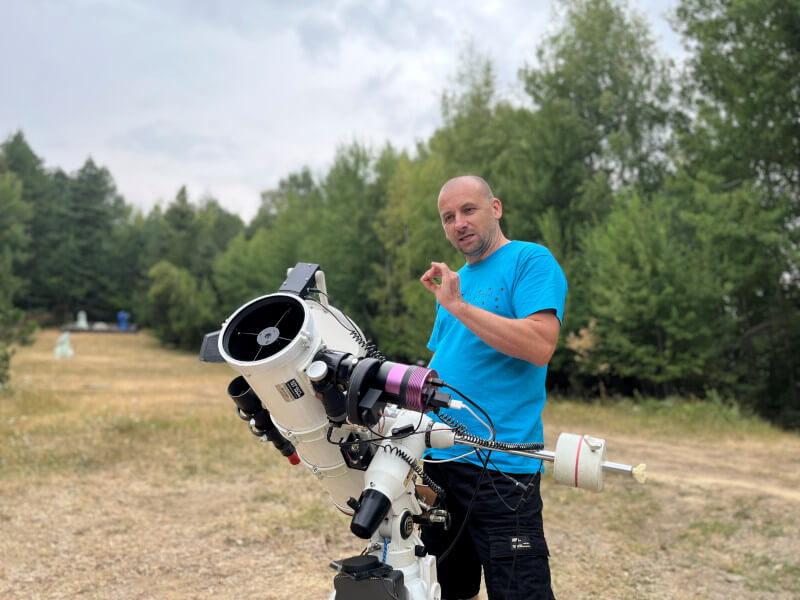
His contribution is far from small. With tens of thousands of variable star observations, his data are used by international research teams. He has earned multiple awards from the American Association of Variable Star Observers, and one professional astronomer even invited him to co-author a scientific paper.
At Belite Brezi, he leads astrophotography groups, passing on skills you can’t pick up from textbooks. “You need hands-on practice—just knowing the theory isn’t enough. I’m a practical guy: give me the equipment and I’ll have it ready in seconds,” he laughs.
Not far away, Associate Professor Dr. Milen Minev chats with a group of students. He has operated some of Europe’s most powerful telescopes—the MAGIC and LST-1 in the Canary Islands—and now runs the new 1.5-meter telescope at Bulgaria’s National Astronomical Observatory at Rozhen, the largest in Southeast Europe. Even with a career in cutting-edge research, he remains committed to teaching. At the Smolyan Planetarium, he works with students from all over Bulgaria, and here at the school he guides them through real observations.
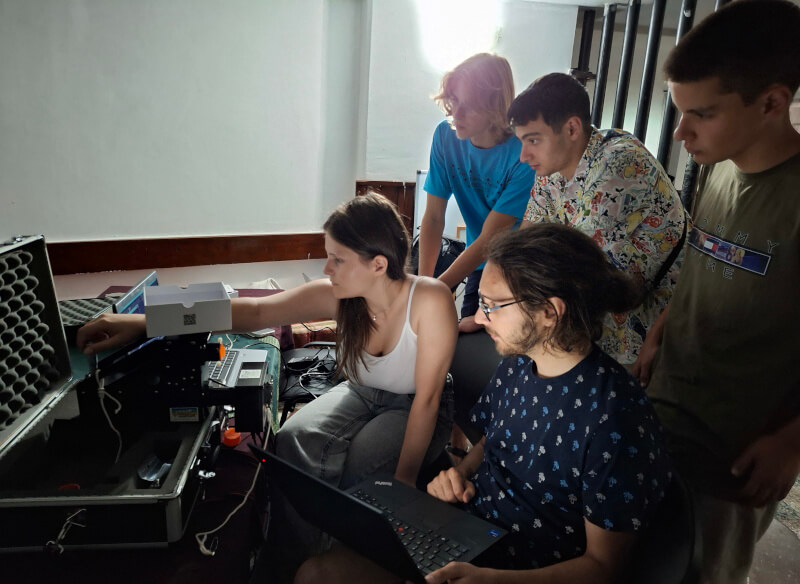
“Schools like this are invaluable,” Milen says. “They help young people figure out what they want to do. Seeing the process firsthand is different from just reading about it.” Dozens of his former students now work at NASA, CERN, and MIT; in March 2025, one was part of the team that discovered the new planet GJ 3998 d.
Astronomy as a mission
By morning, the meadow is quiet. The telescopes are covered, the cables coiled, a few mugs of tea sit unfinished. Stanislav Stoyanov, who coordinates the school’s academic program, is already making rounds: checking the schedule, confirming topics, making sure every group is ready. “We grew up here,” he says when asked why he devotes so much time to the school.
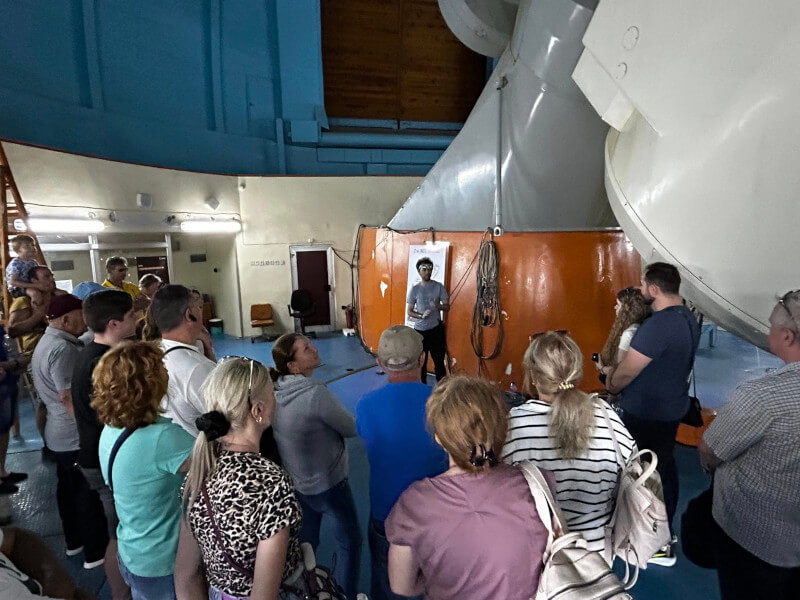
Stanislav lives in Sofia and works in finance, but his roots are in Burgas, where he founded an astronomy school for students of all ages. Almost every week, he travels there to lead workshops and lectures. For him, it’s about building a community where young people don’t just learn about science—they do science. They plan observations, collect and analyze data, and present their findings. At Belite Brezi, he continues that mission, helping curiosity turn into skill, and inspiration into a lifelong pursuit.
Mentors: the backbone of the program
At Belite Brezi, every mentor is a volunteer. In the morning, you might find them checking cables or assembling a telescope. In the afternoon, they’re showing a group of students how to use specialized software. By night, they’re fine-tuning the optics for the evening’s observations. Every mentor was once a student here, and they know how much it matters to get encouragement just when you’re wondering which way to go.
They are the bridge between generations, passing down not only knowledge but the spark that lit their own passion. For some alumni, the first step toward a future career began right here on this meadow. Today, some are at NASA, the European Space Agency, or CERN; others are in leading universities, technology companies, or applying scientific thinking in fields like finance, education, and entrepreneurship. Wherever they are, they are often standouts in their fields. What unites them is the confidence that they can figure things out—and the habit of working together—skills they learned here.
And every summer, when red lights flicker between the telescopes and someone calls out softly in the dark, “Got it!”, the story begins again—just as it has for more than half a century.
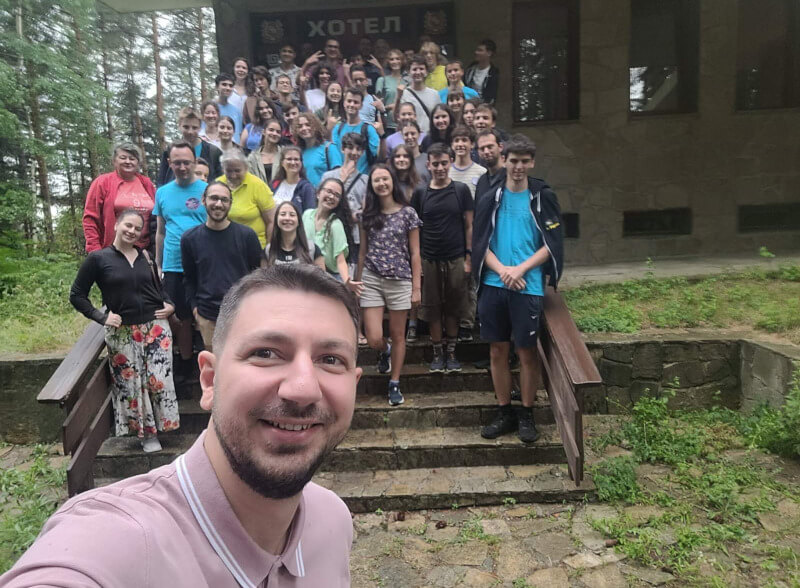
The America for Bulgaria Foundation supports Bulgarian science by backing programs like Belite Brezi Astronomy and Astrophysics School.