Milena Dragijska is CEO of Lidl Bulgaria, the Bulgarian arm of the international supermarket chain, and one of the country’s most prominent business leaders. Yet when she speaks about her greatest achievement, she does not begin with the size of the company or her professional accolades. She goes back to 1996–1997, when she was 22, graduating in the midst of one of Bulgaria’s most severe economic crises and wondering whether it was possible to succeed without compromising her conscience.
Today, her answer is clear: it is possible, but not alone. Dragijska speaks with gratitude about the people with whom she has built a community grounded in professionalism and shared values. She also holds the uncommon conviction that personal success matters only when it helps the people around you grow.
There is something of the civic-minded nation builder in her understanding of success: creating opportunities for others, putting knowledge and influence to work for the public good, and serving one’s country through sustained effort rather than grand declarations. That effort may take the form of decent working conditions, support for civil society organizations, education for children, environmental protection, or helping the Bishop’s Basilica of Philippopolis receive the international recognition it deserves.
Dragijska believes that business can be a force for reform and that small, everyday actions can accumulate into collective power. Helping Bulgaria advance is not a cause reserved for her free time. It is part of how she chooses to work, lead, and live.
America for Bulgaria Foundation: Five years after it opened to the public, the Bishop’s Basilica has become one of Bulgaria’s most recognizable cultural landmarks. Efforts are now focused on securing its nomination for UNESCO’s World Heritage List. Why was it important for Lidl to support the Basilica on this journey?
Milena Dragijska-Dencheva: We had two main reasons. The first is that the Basilica has enormous potential to raise Bulgaria’s international profile. It could also end a 40-year drought during which Bulgaria, despite its extraordinary cultural and historical heritage, has not had a new site added to UNESCO’s World Heritage List.
The second is that we need a clear demonstration of what can happen when business, civil society, and public institutions unite behind a cause of unmistakable importance and follow a structured process to see it through.
ABF: The campaign will direct funds raised through returned cans and plastic bottles toward the Basilica’s UNESCO nomination. It connects sustainable behavior with the preservation of cultural heritage. How did the idea come about?
M.D.: The idea predates our partnership with the Basilica. Our pilot project for collecting cans and plastic bottles has been running for almost three years, and we have expanded it several times.
I call it a pilot project because Bulgaria still does not have an operational national deposit-return system. Our goal was to test how ready Bulgarian society was to embrace the circular economy. We also wanted to put the bottle-to-bottle principle into practice, with returned packaging recycled and reused as industrial raw material. Under the system, customers receive an eco-voucher worth 2 euro cents for every item they return, which they can then use when shopping. The response from the public was remarkable.
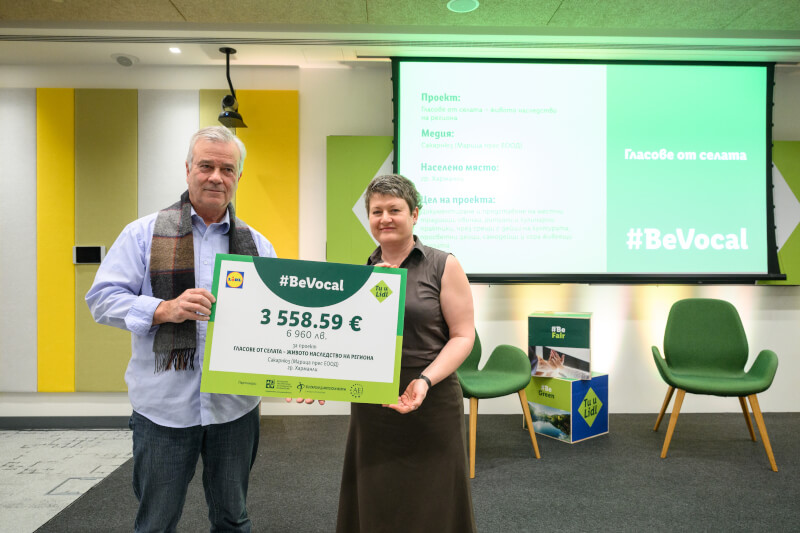
We later decided to give people another choice and added a donation option to the reverse-vending machines. Instead of using the eco-voucher themselves, they can donate the amount directly. We began by supporting the Caps for the Future initiative of the Lazar Radkov Foundation and later added three more nationwide causes: WWF Bulgaria, Animal Rescue Sofia, and the Association of the National Science Olympiad Teams.
To build on this opportunity and demonstrate the real power of collective effort, we made a strategic decision: once a year, the platform would embrace one exceptional national cause in need of urgent, focused support at a pivotal moment.
That is how we arrived at the idea of connecting an established sustainable habit—one proven to inspire people to donate—with the preservation of our history. The Bishop’s Basilica is the perfect example: we are turning a simple, everyday gesture into an opportunity to make a meaningful contribution to our cultural heritage and the Basilica’s path toward UNESCO.
ABF: Recycling is usually associated with protecting the environment. Here, it also becomes a way of caring for history. Do you hope campaigns like this can change how people think about their role as citizens?
M.D.: Absolutely. The belief that small, everyday actions can bring about change lies at the heart of everything the Lidl team does in corporate social responsibility, particularly through You and Lidl, our largest community support initiative.
For many years, Bulgarian society was burdened by the deeply damaging belief that one person could not change anything. Collective responsibility stands in opposition to the collective irresponsibility that has so often taken hold as a kind of creed. Volunteering and doing good together are democratic expressions of that responsibility.
It does not matter whether a small community comes together to repair the playground outside an apartment building, protect an endangered bird species at Atanasovsko Lake, equip a modern English classroom, or return bottles to support both a cleaner environment and a nationally important cause. All these actions express the democratic idea of collective responsibility.
ABF: Every large company receives many requests to support worthy causes. How do you decide which ones merit a long-term commitment?
M.D.: One important criterion is the connection to our core business. That creates logic, consistency, and trust. We look for causes that naturally align with our corporate strategy and values.
The second is alignment with our strategic and operational goals. Our financial resources are limited, so we have to use them as effectively as possible.
The third criterion is the likelihood of achieving sustainable results. We seek a return not in the narrow financial sense, but in the form of real, lasting, and measurable positive change for the people whose needs we are trying to address.
Finally, our partnerships with established civil society organizations help us assess applicants in terms of reputation, organizational capacity, good governance, and their ability to set clear goals.
The hardest decisions come when several projects meet all these requirements. At that point, however strongly we may feel about a particular idea, we have to make difficult strategic choices, guided by the discipline of supporting the project where our scale can produce the greatest collective impact.
ABF: At Lidl, social causes often seem to be part of how the company defines success rather than something added on afterward. Is that a leadership philosophy, a matter of corporate culture, or both?
M.D.: The two are closely connected. I would add a third element: the sense of responsibility among our team members themselves.
I am both proud of and grateful to our Bulgarian team for developing a distinctive approach of its own. You and Lidl, for example—our flagship program, through which we fund and carry out hundreds of meaningful community development projects across Bulgaria—originated entirely within Lidl Bulgaria. No equivalent initiative exists in the other 30 countries where Lidl operates.
Another example is our systematic work to promote more conscious eating. For us, the subject extends beyond the usual idea of “healthy eating” and considers the health of people and the health of the natural world together. That is why we are making concrete changes to our business model. This is most evident in our work to reformulate our own-brand products, for example by reducing added salt and sugar. We are deliberately increasing the share of whole-grain foods in our product range and continually expanding our selection of plant-based products.
What is more, we follow extremely strict rules on responsible marketing to children because we recognize how much influence we have on the eating habits they develop.
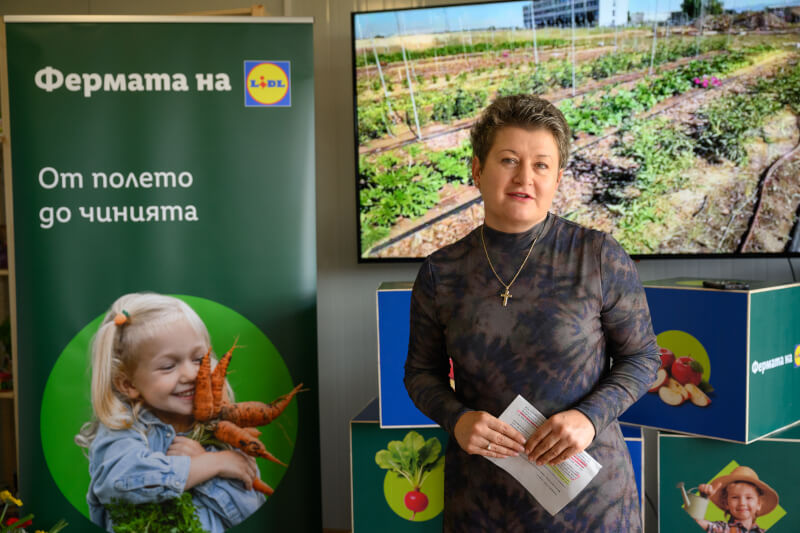
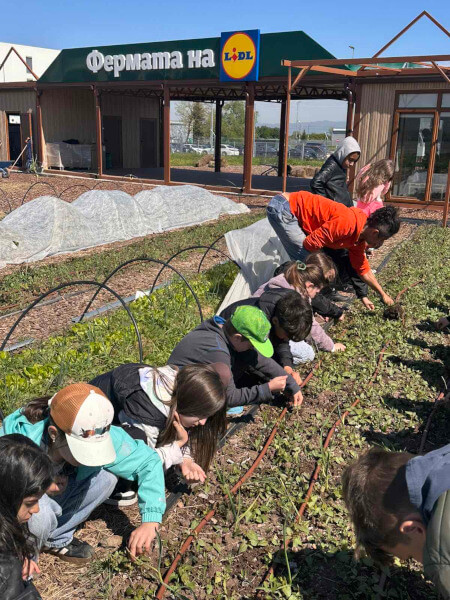
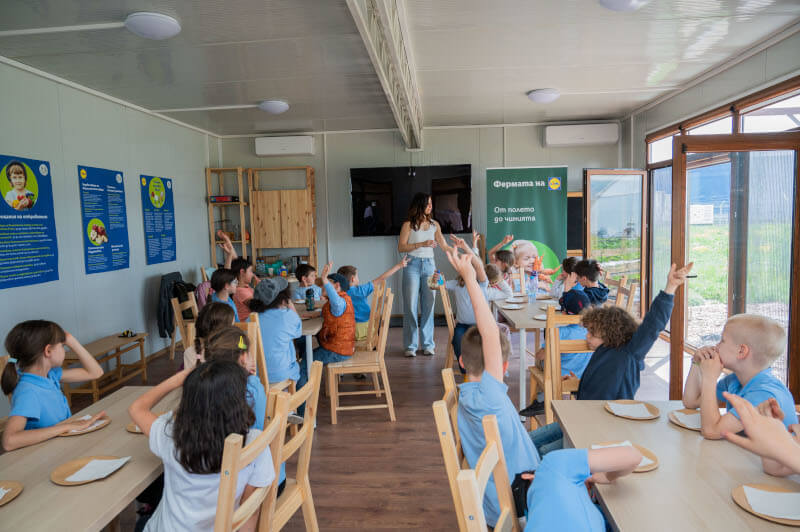
To make this concept easier for people to understand, in 2024 we launched the educational campaign Food with Purpose. More recently, we expanded it through the Lidl Farm experience, where our educators and a professional agronomist show children how food travels from field to plate and teach them about healthy and conscious consumption.
This educational garden is currently attracting great interest not only from schools, but also from other organizations that work with children.
These business decisions are part of our success and are directly connected to our corporate culture. We are fortunate that our parent company encourages us to work in this direction and sets very ambitious goals of its own. Leadership and innovation are encouraged, while the Bulgarian team retains its distinctive local approach and its ability to identify the right issues and solutions.
ABF: You have worked with civil society organizations for many years. What can they offer business that companies would struggle to achieve alone?
M.D.: At least two things. The first is hands-on expertise rooted in communities. We may have assumptions about the needs within a particular field, but we lack the deep, close-up understanding that comes from working on the ground.
Everyone has an opinion, especially after personally encountering a particular difficulty. But that opinion is often based on an isolated experience. When you want to achieve systemic change, you need an expert, not only to diagnose the problem, but also to identify the measures capable of changing the situation.
The second thing is trust. For a variety of social and political reasons, people often suspect that whenever a corporation launches an initiative, a narrow commercial interest must lie behind it. A civil society organization can act as a kind of interpreter between a company’s intentions and the local community the assistance is meant to reach.
That injection of trust shortens the distance between the two and accelerates results.
ABF: For the past five years, you have been not only a partner of the America for Bulgaria Foundation, but also a member of its Board of Directors. How has that changed your view of civil society organizations?
M.D.: I can say with certainty that many business leaders do not fully appreciate the professionalism within civil society. There is still a widespread impression that these organizations are simply groups of underfunded enthusiasts who may not know exactly what they are doing but want to accomplish something good.
That is simply untrue. They operate with rigorous accountability and clear principles.
Another thing I have seen from the inside is the breadth of their perspective and the depth of their understanding of social problems. Because resources are scarce, civil society is often forced to live by the principle that less is more. You genuinely have to prioritize, ensuring that what is both urgent and important comes first.
When you are accustomed to achieving results with limited resources, you become intensely focused on effectiveness. That often surprises people in business, who tend to regard efficiency as a quality belonging exclusively to the corporate world.
The third thing is the remarkable positive human energy. Civil society organizations often work in areas defined by difficulty and crisis, yet they generate an extraordinarily constructive spirit. Both our team and our civil society partners recognize this. The events I attend with the greatest pleasure are meetings with projects supported through You and Lidl, including our media initiatives and the campaigns connected with returned bottles and cans.
ABF: When is a partnership between a company and a civil society organization genuinely meaningful rather than merely good for appearances?
M.D.: When it seeks systemic change. That is perhaps the clearest sign that the partnership exists beyond paper and is not simply a public relations exercise.
It requires regular accountability, a shared willingness to work, and a clear division of responsibilities based on expertise. Business can provide scale and financial stability. A civil society organization contributes knowledge and a direct connection to the issue. Together, they should produce systemic solutions and lasting change.
The Bishop’s Basilica also demonstrates that we can work together—that division is not our only option and that collaboration can produce visible results.
ABF: What is the role of business in a democratic society, particularly in an environment where trust, rules, and institutions cannot be taken for granted?
M.D.: The role of business is to create value. Its most fundamental responsibility is, of course, to generate economic value: gross domestic product, goods, jobs, and wider social and economic benefits.
But business also creates value through good practices. We all remember the early years of Bulgaria’s transition from communism to a market economy and the enormous scale of the informal economy.
Today, we take it for granted that employees should be officially registered at their full salary, with all the corresponding taxes and social security contributions paid. Just 20 years ago, that was far from standard practice. Responsible companies set a different tone and helped change the way business was done.
Business also creates reputational value. If Bulgaria is known as a good place to invest, that reputation travels and attracts other companies.
It creates value when Bulgarians begin to ask themselves whether to leave the country or build their lives here. We are not yet seeing people return on a massive scale, but there is some movement in that direction, and business has played a part in it.
Business can also change the physical environment. If one company plants trees in front of its new building and repairs the pavement, the next company is more likely to do the same.
Responsible companies also have a role in resisting corruption. It was an important step when more businesses began to say, “We do not operate with secret cash reserves, and we will not play by those rules.”
In this sense, business has a reforming role, even if that is not always obvious at first glance.
Then there is the collaborative effect between business and civil society. Civil society organizations have taken on many responsibilities from which the state had, for various reasons, withdrawn. Without them, many people would not have been able to study abroad and later return as successful professionals. Community cultural centers, museums, and many other public spaces would not have been restored.
These results have also been made possible by business, because much of the funding for civil society organizations comes from companies.
We still have a long way to go, but we have also traveled an extraordinary distance. We should learn to acknowledge that, both as a business community and as a civil society sector.
ABF: You are one of Bulgaria’s most recognizable business leaders. Which early experiences shaped you most strongly as a person and a leader?
M.D.: I would group them into several categories. The first consists of vivid childhood memories of limited opportunity. You wanted something, but you could not pursue it—whether for financial reasons or because the borders were closed and travel was restricted under communism.
That became a powerful motivation. I always wanted to study abroad, not so that I could remain there and forget Bulgaria, but so that I could learn directly from a world I had previously encountered only through books. And even books were restricted; someone else decided which ones could be translated and published.
The radical economic and political changes were also important. They found me at 16 or 17, an age when a person is already capable of reflecting seriously on what is happening around them.
The second category is people: encounters with exceptional individuals who gave me a great deal. Their lessons have remained with me throughout my life.
ABF: Which of your achievements make you proudest?
M.D.: That is difficult to answer because the achievements are not mine alone. I am a fortunate and blessed person because the things I believed were important, and still believe are important, have come about through the efforts of the people around me.
I found the strength and the time to tell myself that I could be a mother as well as have a professional career. That is not exactly a source of pride; rather, I am grateful to have two children.
God has also allowed me to be surrounded by professionals and by people who share the same values. Because of that, I believe it is possible to succeed without compromising your conscience or your principles.
I will never forget being 22 and completing my university education during Bulgaria’s devastating economic crisis of 1996–1997. At the time, it was far from clear that a person could succeed without paying some hidden price.
We all remember who had become entangled with certain circles and relationships in those years. That frightened me deeply because I instinctively wanted to succeed. I do not think there is anything shameful about aspiring to more or about not wanting to live in a run-down student dormitory.
But a warning bell would immediately ring inside me: “My God, what compromises will I have to make with myself? And am I willing to make them?”
That is the achievement of which I am proudest: I did not have to make those compromises.