Listen to the story: 12:04 min
When you visit a new city, your instinct is to start with the museum: the glass cases, the labels, the hush. You often leave with more facts than feelings.
Plovdiv isn’t that kind of city. Its character lives in the streets, in the slow rhythm of its center strolls, in the stories of its local eccentrics, in a pace of life that refuses to be hurried.
If you’ve never signed Autograph Stephan’s notebook, bought socks from Mitko the Sock Man, gotten lost in the labyrinth of Kyuchuk Paris, or sipped Turkish coffee at Dzhumaya Square while half the city walks by—if you’ve never truly engaged in aylyak (embraced the local art of taking it slow)—then you haven’t really experienced Plovdiv.
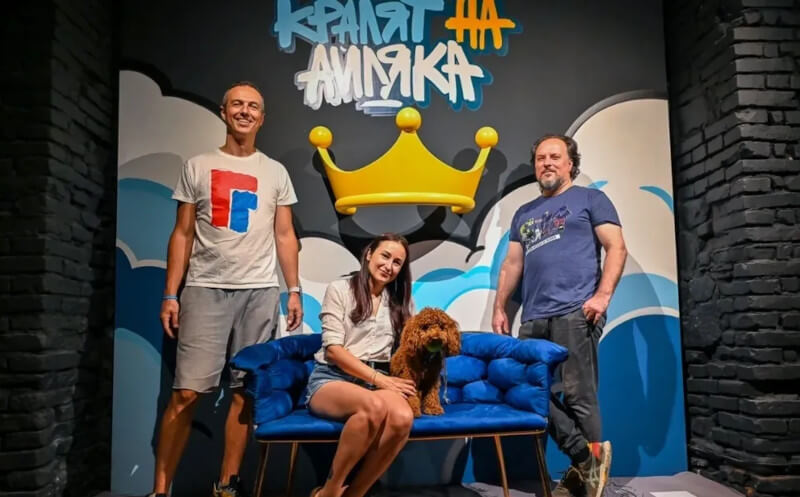
And that’s exactly what the team behind Maina Town wanted to change. In August 2025, they opened the Fantasy Non-Museum of Plovdiv—right in the heart of the city, on a corner well known to locals and easy to find for visitors.
The Berlin spark and the first T-shirts
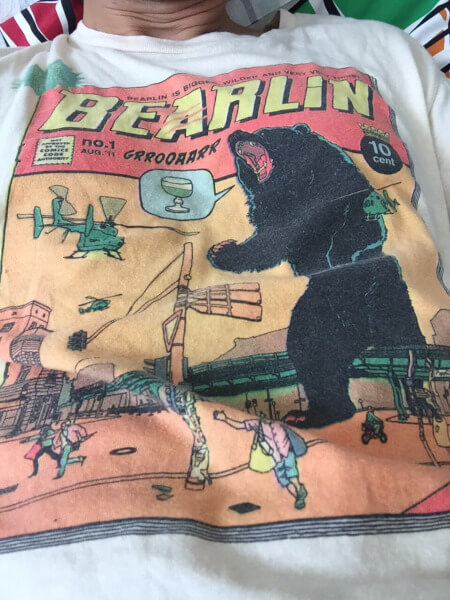
The story began ten years ago, when Todor Popov, then a financial director at an international tech company, returned from a work trip to Berlin with a gift: a T-shirt featuring a bear and the word Bearlin. A simple joke that somehow captured the city’s spirit. “I thought, why don’t we have something like this for Plovdiv?” recalls Todor. “Something fun, but also truly ours.”
He shared the idea with Ani Yordanova, his partner in life and an artist discovering her passion for graphic design, and with Dimitar Petrov, a childhood friend and illustrator of children’s books and encyclopedias.
The three started thinking about how their city really looks—not in tourist brochures, but in its living, everyday version, where monuments have a sense of humor and the city’s hills seem to whisper.
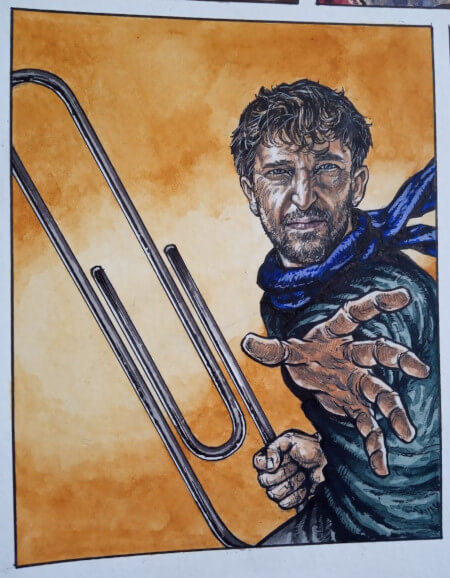
“I’ve been drawing Plovdiv since I was a kid,” says Dimitar. “The city is full of characters. We just had to draw them the way we see them—with a wink.”
Ani remembers the first design: “Dimitar drew Alyosha [a Soviet-era monument towering above the city and visible from almost anywhere in Plovdiv, ed.] as a comic hero, leaning over the Old Town. I added a speech bubble, and that’s how ‘Alyosha Looking for Vodka’ was born. Then came another, featuring Atlas [the Titan from Greek mythology whose statue crowns one of the old downtown buildings and has long been a Plovdiv landmark, ed.] holding beach balls instead of the globe. We didn’t yet know we’d started something big.”
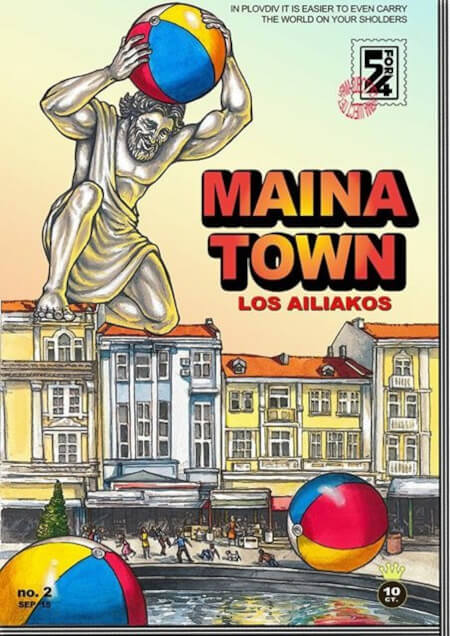
The T-shirts became a hit. People wore them proudly, sent photos from abroad. “A T-shirt isn’t clothing. It’s a platform for an idea,” says Dimitar. “Whoever wears it declares that they care—about the city, about irony, about belonging.”
That’s how Maina Town was born—not just a project, but a platform for local culture that began telling Plovdiv’s story through art, humor, and urban legends.
From T-shirts to comics, books, and community
The next step came naturally. The team decided to turn their visual humor into a book. “We wanted to make a guide—not to streets, but to feelings,” says Todor, who is the driving force behind most of Maina Town’s wild ideas. That became the 2018 Plovdiv: A Fantasy Guidebook, a comic-style collection of stories inspired by real places and real characters. Elon Musk lands in Stolipinovo, Alyosha joins an intergalactic adventure, and the city’s seven hills host clashes between past and present. The first print run sold out within weeks.
With every new project, Maina Town has evolved into a cultural movement that keeps the city buzzing. Its Maina Town Weekends turn Plovdiv’s streets into open-air galleries, and RE:Bazaar gathers artists, small businesses, and eco-minded makers under one roof. “Culture doesn’t belong only in galleries,” says Dimitar. “We want it to happen everywhere.”
Over time, new heroines joined their universe—Melpomaina, Kapana Karenina, and Zuma Thurman, muses of Plovdiv—witty, bold, and full of charm, giving the city a voice of its own.
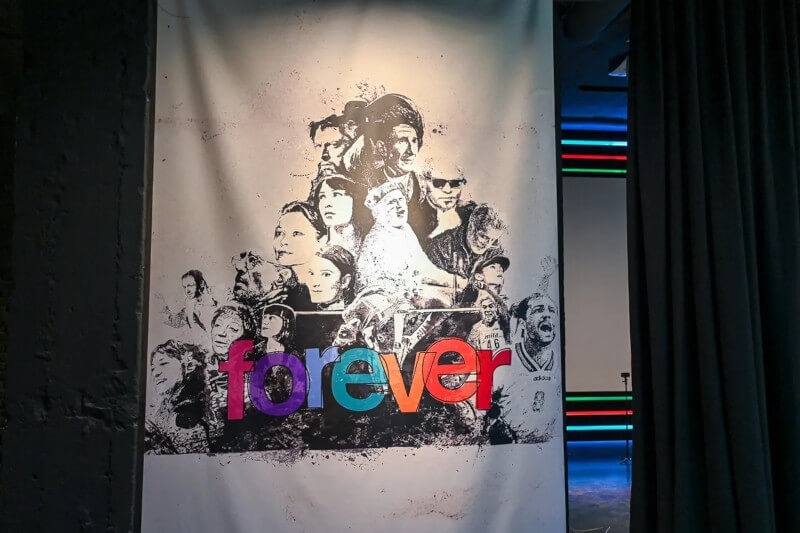
Soon, the team began creating Fantasy guides for other cities, bringing the same sensitivity to local culture through humor, art, and storytelling.
How the Non-Museum was born
After years of experimenting with formats, Todor, Ani, and Dimitar realized Plovdiv deserved a place where all these stories could come alive together. “It was a natural next step,” says Todor. “We already had the characters and the visual world; we wanted people to walk into it and experience it.”
The team imagined a space that wouldn’t archive life but activate it. Hence the idea of a Non-Museum—not because it rejects museums, but because it refuses to trap life behind glass. The three-story house in the city center turned out to be the perfect vessel for such an experiment: downstairs is all echo and history; upstairs—light and mood; in between—a staircase that’s a story in itself.
The process took almost two years. Dimitar played a key role, coordinating the design, graphics, and the physical build. “In theory, it all seemed simple,” he says. “In practice, we had to figure out how to make a giant 3D book that could survive being touched, how to bring a dragon to life through a camera, and how to make everything not only beautiful, but durable.”
Meanwhile, Todor and Dimitar joined the Muse Academy of the America for Bulgaria Foundation, a program about creating modern museum experiences. There they discovered a new storytelling language, one of space, sound, and interaction. When they returned to Plovdiv, the Non-Museum idea already had both a vision and the tools to make it real.
Around the trio, a team of more than 20 artists gathered: graphic designers, illustrators, scenographers, architects, curators, musicians, and creators of interactive content. The result is the Fantasy Non-Museum, a three-story house with no showcases, only experiences.
Inside: a city laughing at itself
The first thing you feel when you walk in is that you’ve stepped inside a story.
Instead of signs and guards, there are interactive installations, sound, motion, and humor. In the first room, a sad-eyed dragon comes to life, watching you as you uncover its secrets. In the next room, you spin the Wheel of History, an interactive AI experience that takes you through different eras, transforming you into a person from the past, complete with the clothes and hairstyle of the time. In another, you put on boxing gloves and let off steam on an interactive wall. A few steps later, the Plovdiv Dictionary awaits—to remind you that aylyak (that signature Plovdiv ease) simply cannot be translated.
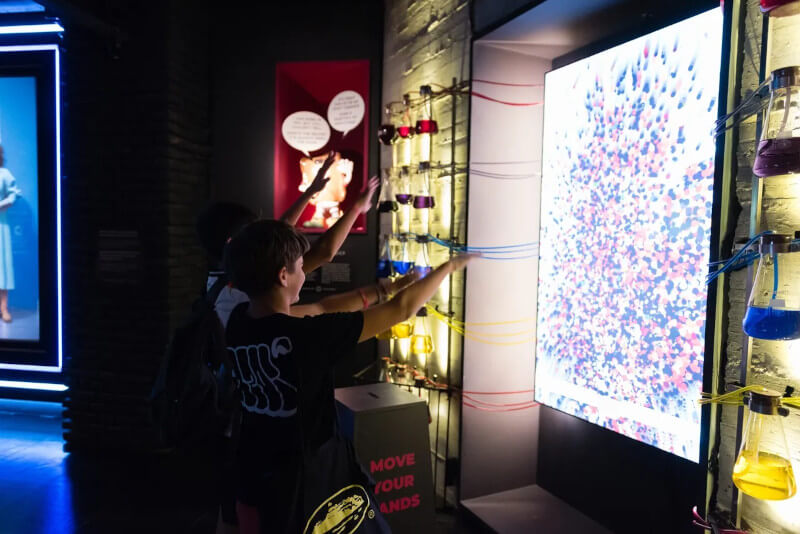
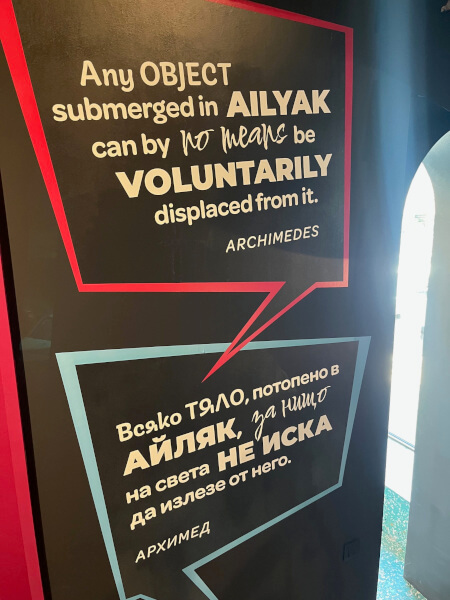
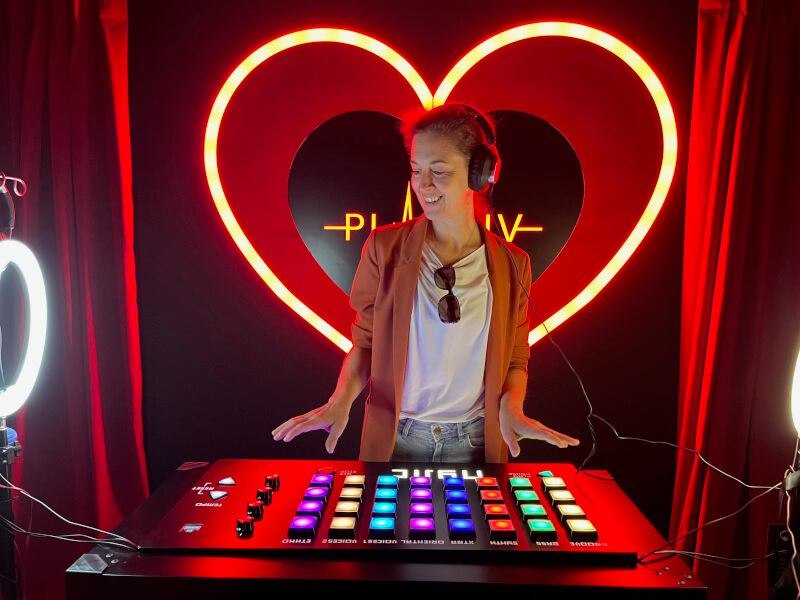
As you climb the stairs, you pass quotes celebrating aylyak—including one attributed to “Archimedes”: “Any object submerged in aylyak can by no means be voluntarily displaced from it”—until you reach the top, the Heart of Plovdiv, where the walls pulse to the rhythm of the city. There, “gusto” is no longer a word but a feeling—of joy, lightness, and belonging.
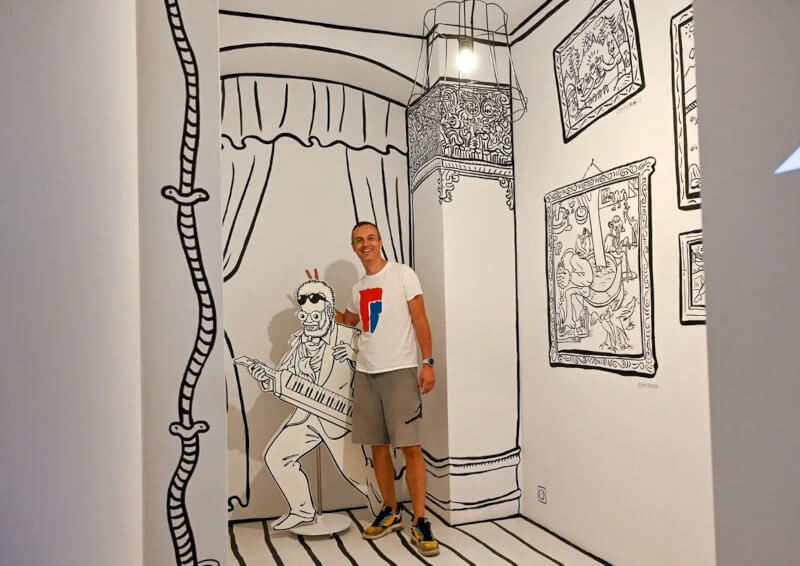
One of the highlights is a giant 3D book of Plovdiv’s neighborhoods, designed by Dimitar himself. “The idea was that you could open it, take a photo, and feel like a comic book hero,” he says.
The Non-Museum also pays tribute to local legends like Mitko the Sock Man, Autograph Stephan, and Maestro Bhagavan. “They’re part of the city’s living mythology,” says Todor. “We just gave them a story and a place.”
Aylyak as an esthetic, not an excuse
Plovdiv’s aylyak lifestyle is often mistaken for laziness. Here, it’s a way of being—unhurried, observant, delighting in the details. To engage in aylyak means to have time for a conversation, for a pause, for playfulness. The Non-Museum doesn’t tell you to relax; it makes you relax, almost without noticing. And when you step back out onto the main street, you suddenly understand why this is the “city of seven hills,” even if the count doesn’t quite add up; why “gusto” means more than “I like it”; and why the stories of places and people matter just as much as the ancient ruins.
Plovdiv without the glass case
Today, families, students, and tourists stream through the Non-Museum. Some come for photos, others for inspiration, and many simply out of curiosity. Almost everyone leaves smiling. “When people walk out saying, ‘That was so much fun, and we learned something new,’ that’s when I know it has been worth it,” says Ani.
The Non-Museum is a living organism, constantly evolving, adding new rooms and characters, with plans for traveling installations across other cities. “We don’t want to be a place people just look at,” says Todor. “We want to be a place people experience.”
Where to find it—and how to experience it
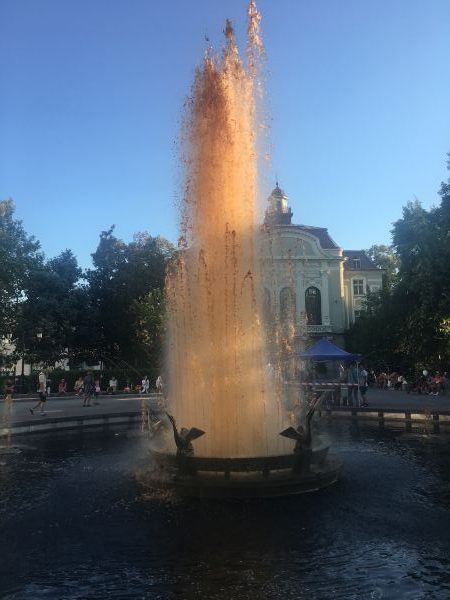
The Fantasy Non-Museum sits right in Plovdiv’s beating heart, by a foundation that actually flowed with Coca-Cola—for a short while, during an art installation in 2017. Don’t plan ahead; that’s not the local style. Drop by between meetings, bring the kids after school, or wander in with friends on a Saturday. The odds of leaving with a grin are high. School groups visit, international students stop by after the Ancient Theater, families celebrate birthdays—because it’s fun, hands-on, and, as locals would say, because it’s gusto.
A city that breathes
People often call Plovdiv “the city of seven hills.” Everyone knows there are six now and once there were nine. But no one argues about the numbers. “That’s just how Plovdiv is,” smiles Todor. “We’re too aylyak to count.”
The Non-Museum captures exactly that—the spirit of a place that doesn’t try to be perfect, only real. A place where humor and self-irony are part of its cultural DNA. A reminder that Plovdiv isn’t just architecture and history; it’s a feeling that makes you smile, even when you don’t understand everything.
Maybe that’s why the Fantasy Non-Museum is the most Plovdiv thing that could ever happen to this city.
Fantasy Non-Museum
1 Patriarch Evtimiy St., Plovdiv, Bulgaria
Open daily, 10:00 a.m. – 10:00 p.m.