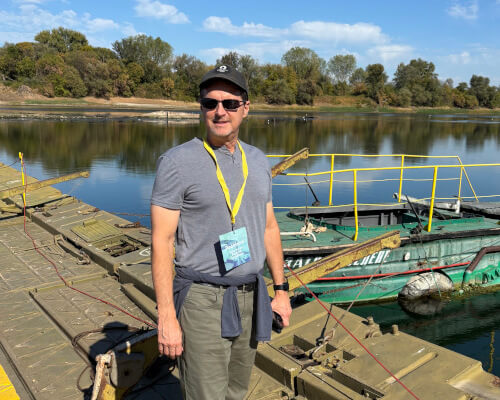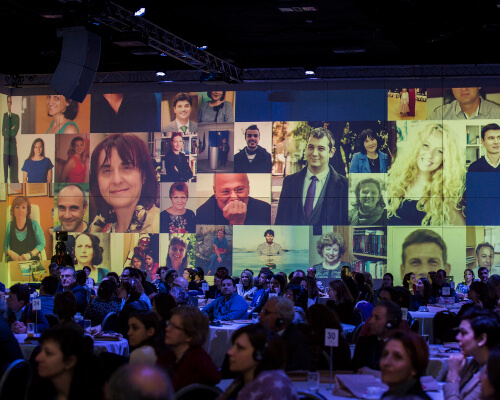
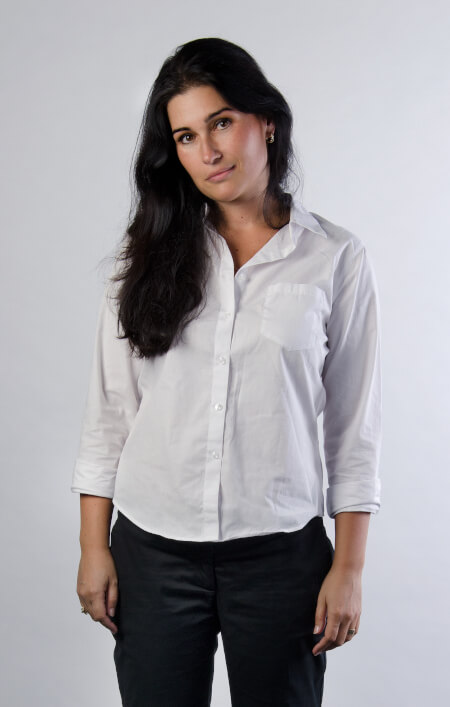
Ludmila Kissiova is deputy manager of RISK Electronics, the company behind the exhibition The Soldier in Human Uniform.
Her résumé is not long. But most people would need several lifetimes—and at least three university degrees—to accumulate the experience Ludmila Kissiova has gained at RISK Electronics.
How to configure a laptop. How a smart waste-collection system works. What kind of connectivity a hospital needs to run smoothly. How to rethink an office space down to the smallest detail. And where to find authentic early-twentieth-century soldiers’ boots. These are just some of the skills Ludmila has picked up over 27 years at RISK Electronics, the family company she now runs together with her brother, Georgi.
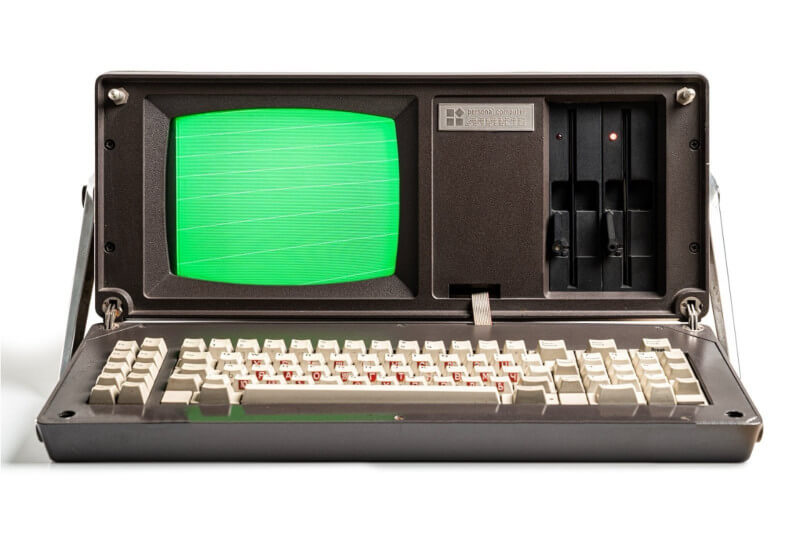
The company is among the first private technology firms established in Bulgaria after the fall of communism in 1989. For many years, it produced its own brands of computers and servers. Over time, RISK Electronics expanded into developing comprehensive technology solutions for businesses and public institutions, including immersive digital experiences.
One such project is the exhibition The Soldier in Human Uniform at the Regional History Museum in Pleven, created with the support of the America for Bulgaria Foundation.
The exhibition tells the story of the bravery of Bulgarian soldiers during the wars for national unification between 1912 and 1918—but also of the human being beneath the uniform. Of letters written hurriedly between battles. Of evenings in the trenches and the small gestures soldiers used to encourage one another. Of the urge to create even in the middle of war: candlesticks, inkwells, and figurines made from spent shell casings.
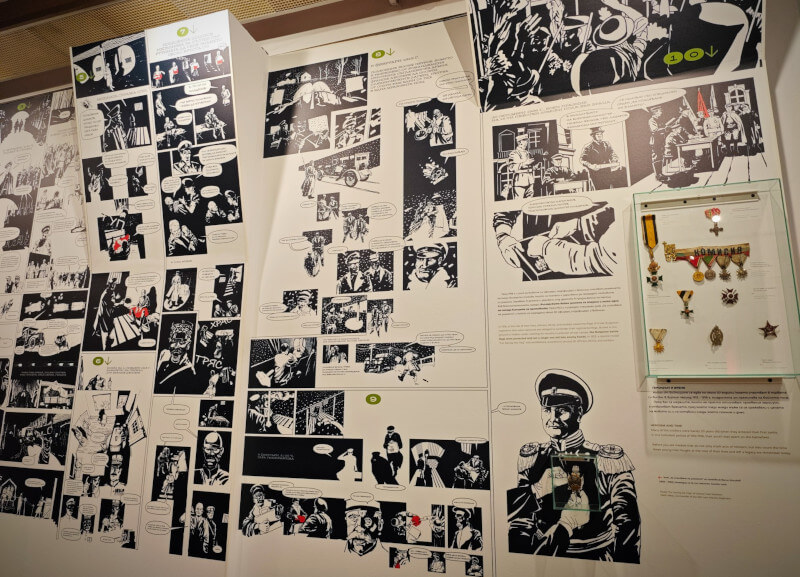
Some of the stories are designed to speak even to the youngest visitors. The dramatic rescue of the Bulgarian flag, for example, is presented through a comic strip, accessible and engaging for audiences of all ages.
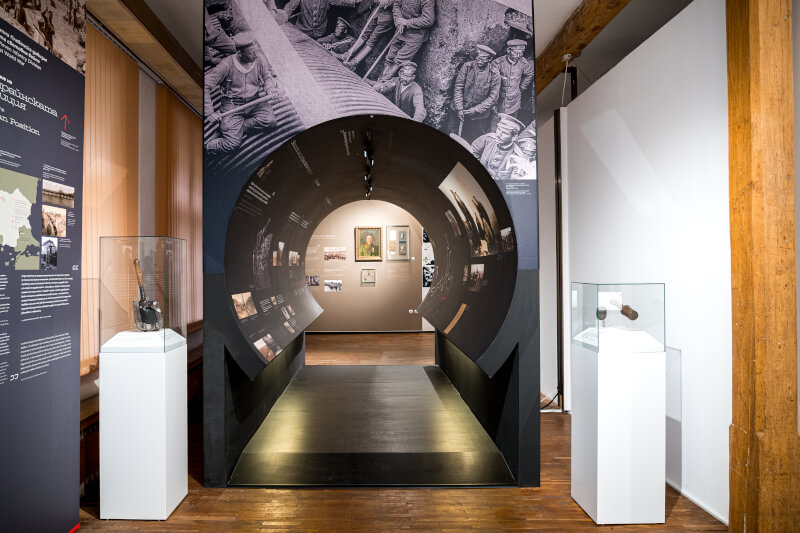
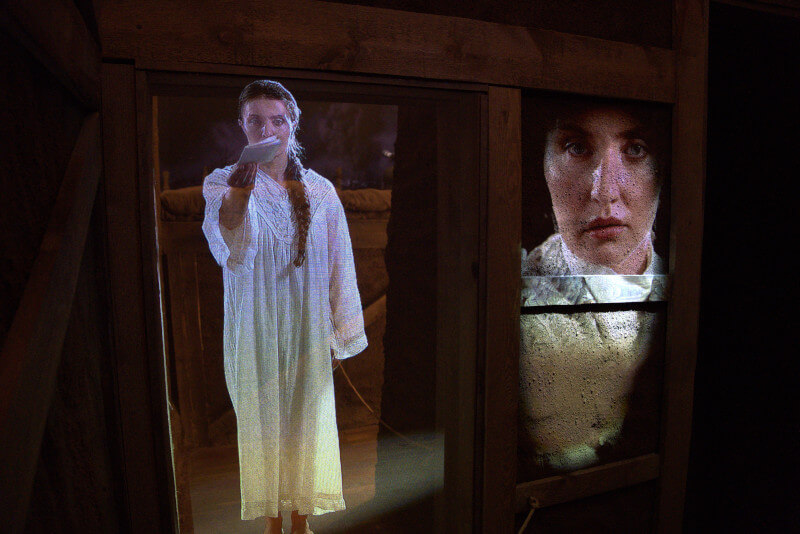
Technology turns visitors from spectators into participants. One moment you find yourself in a frontline trench, the ground trembling from explosions. The next, you are far from the battlefield, by a hearth, beside a woman writing a letter to the man she loves.
We spoke with Ludmila Kissiova about the creation of The Soldier in Human Uniform and about how technology can make historical storytelling more vivid and accessible. We also talked about running a family business, especially one that belongs to the first generation of IT companies in Bulgaria. And about something else: how a small Bulgarian company continues to find its place in an era dominated by global technology giants.
America for Bulgaria Foundation: When people hear “technology company,” they rarely imagine an exhibition that engages them emotionally and keeps them riveted for hours. What did you learn about the power of technology while working on projects like this?
Ludmila Kissiova: I learned that technology should never exist for its own sake. It exists to serve people. If it doesn’t add value to our lives, there is no reason for it to exist.
In projects like this, technology contributes in a very particular way. There are really no limits to where it can be used. What matters is knowing how to use it properly, depending on the context and the purpose.
Today technology is so flexible that it is no longer limited to screens, video walls, or kiosks. It can be very discreet, almost invisible, integrated into the space so naturally that visitors simply experience the result without thinking about how it was achieved.
ABF: What matters most when working on projects related to cultural heritage?
L.K.: Choosing the right technology. Museums require a broad understanding of what’s possible. To do that well, you have to keep track of what is happening around the world. Not because you want to copy it, but because sometimes that’s exactly what sparks a new idea.
But the most important thing is that technology should never lead the project. The content comes first—the story you want to tell. Technology is simply a tool that helps people understand and experience that story more deeply. It should never overshadow it.
ABF: When do you know you’ve done your job well?
L.K.: Usually when we talk with people afterward—clients, partners, visitors.
Sometimes you don’t even have to ask anything. You can see it in their faces. You feel it in their reaction, in the energy. And that’s when you know it worked.
ABF: Is there a particular visitor reaction that has stayed with you?
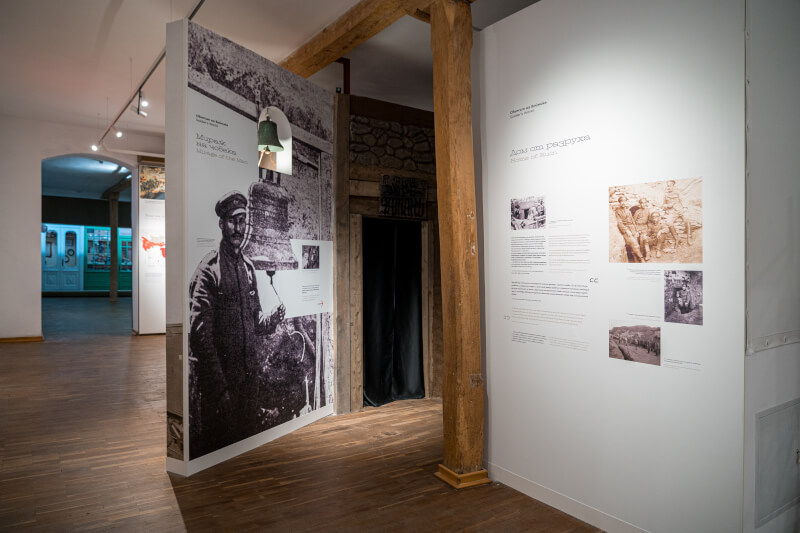
L.K.: What I remember most is the atmosphere at the opening. Everyone seemed to find something that drew them in: the bell, the tunnel, the projections.
I have a special fondness for the bell. My colleagues ordered it, but I picked it up from the shipping company and drove it to the office. The whole way it kept ringing in the back seat. I felt as if I was driving a bell tower.
Finding a bell like that and preserving it felt special. These things are not easy to come by.
Later we also managed to find soldiers’ boots. I ordered them myself, received them in Sofia, and drove them to Pleven.
ABF: So sometimes the boss ends up transporting bells and boots?
L.K.: Apparently, yes.
I try to help any way I can. If I have the time, I help even with practical things like orders and deliveries. It’s all part of the project.
ABF: How do you see the company’s work in the field of cultural heritage developing?
L.K.: It’s a niche field, very specific, especially if you don’t want to approach it with templates. And that’s something we try hard to avoid.
We’re not interested in simply selling digital solutions. What matters to us is the concept behind them.
This will remain part of our portfolio, but we would like to see more projects actually realized, not just conceptual proposals. Of course, a lot depends on museums themselves, their vision, their budgets, and their possibilities.
ABF: If there were no limitations, what would you most like to create in this field?
L.K.: We would probably allow ourselves to dream a little more.
But the most exciting moment is when a concept actually comes to life and begins to function. That’s when you see how people interact with the space and what kind of emotions it creates.
Personally, I would love to see even more interaction—not just visitors looking at the exhibition, but becoming part of it in some way.
The best outcome is when you spark curiosity in children.
ABF: Are children the most important audience?
L.K.: I think so. When I was researching museums, I realized how important the educational dimension is. Many museums still struggle to connect with today’s children.
It wasn’t particularly easy when I was young either. Museum visits could be rather monotonous. I loved the Natural History Museum, though. I still remember the crocodile in the entrance hall. Children would knock on the glass and ask if it was alive.
That memory made me realize that technology can create interaction without animals suffering. Holograms, digital elements, different kinds of interactive experiences—these are much better ways to engage children.
ABF: You have worked at RISK Electronics since your university years. What do you do in the company today, and how are responsibilities divided between you and your brother?
L.K.: Our roles are different, but they complement each other. My work is mostly internal: the organization, work processes, and the working environment. Making sure the “house,” so to speak, is stable and reliable.
Sometimes, that also means dealing with very practical things. If something needs to be ordered or a solution needs to be found, I step in.
My brother is much more involved in the company’s development: projects, strategy, and the direction we’re heading in.
ABF: What is the culture of the company?
L.K.: Over the years, one thing has become clear: RISK Electronics attracts and encourages people who think. Not just employees who do a job, but people who look beyond the routine and want to be treated as individuals.
We work as a team, as professionals, but also as human beings. Communication matters to us. No one has to prove themselves at someone else’s expense; everyone knows what they contribute and tries to give their best.
My brother and I also meet with every employee once a year for personal conversations—not formal surveys, but real discussions about how they feel about their work, what works well, and what could improve.
We also try to be understanding. Sometimes people need time off because of children or family situations. We have all been through that. Since 2020, we have worked mostly online, which is also a matter of trust. And I can say no one has ever abused that trust.
Most of our employees have been with us for more than ten years. The colleague responsible for technological solutions has been with the company for over twenty years, and the one who manages the warehouse for more than thirty.
Our team is not large, 22 people, but it is stable and very cohesive.
ABF: The founder of the company is your father. Is it easy to work in a company created by a parent?
L.K.: I cannot really compare. I have only worked here. But there is one important thing: you have to be able to separate family from work.
In the early years, employees were often surprised that I addressed my father as “Mr. Kissiov.” I never said, “Ask my father,” or “My father said.” I always referred to him as Mr. Kissiov. For me, that is the healthiest way for a company to function.
ABF: Your father, Yordan Kissiov, belongs to the first generation of Bulgarian engineers, who developed computer technologies in the 1970s and 1980s. Last year, he told that story in his book The First IT Generation of Bulgaria. Do you feel that his approach, from science to business, continues in the company today?
L.K.: My father comes from the Bulgarian Academy of Sciences—from the Institute of Cybernetics and Robotics. There, he worked on the development of industrial systems and computers. That is where the company’s name comes from. “RISK” is not the English word for “danger,” but an acronym in Bulgarian that stands for Development of Industrial Systems and Computers.
At the time, this work was very well structured and carried out at a high level. The institute worked internationally and participated in exhibitions and research projects. Honestly, even I did not realize all the details until I read my father’s book.
When the political changes came in the early 1990s, that research suddenly lost its support. Creating a private company turned out to be the only logical step forward.
It is difficult to break that thread. The company today is the result of what existed before. My father did not create a company simply to do business. His approach was from science to business.
That is still the approach we try to follow today.
ABF: RISK Electronics has existed for more than three decades, something rare for a small technology company. How do you survive that long in this sector?
L.K.: I don’t think there is a single formula. Business changes constantly, and you have to adapt.
There were periods when the company was much larger. At one point, our team was close to one hundred people across the country. Today we are about twenty. That doesn’t mean we are weaker; it simply means we have adapted to different stages of the market.
Diversification is very important. If you focus on only one thing, the risk becomes much higher. Over the years, we gradually expanded from manufacturing computers and servers to comprehensive technology solutions and, in recent years, to digital experiences.
What has never changed is our concept of what we offer: our solutions have to be competitive internationally.
ABF: After so many years in the family company, what surprises you the most?
L.K.: That we managed to develop so many different directions and still deliver projects successfully.
At one point, I felt we might be losing focus. But projects are completed on time and with quality.
Another surprising thing is how quickly we made the transition from being a manufacturer of computers and servers to a company that provides complete solutions.
ABF: Has your work ever put you in unusual situations?
L.K.: Oh yes. At one point our showroom, normally full of computers and servers, was suddenly filled with huge garbage containers. We were testing a smart waste-collection system for a client and needed to install sensors and measurement equipment.
People would walk into the office and wonder why there were garbage containers in the middle of the showroom.
So the boots and the bell are actually not the strangest things.
ABF: Where do you see RISK Electronics twenty years from now?
L.K.: As a company that continues to transform.
Business is unpredictable, so I cannot say exactly what it will look like in twenty years. The most important thing is to keep analyzing change and adapt quickly enough so that it does not catch you by surprise.
Most likely, twenty years from now, we will still be doing what we are doing today—looking for new directions, adapting, and making sure our solutions stand alongside the best in the world.