Listen to the story: 12:26 min
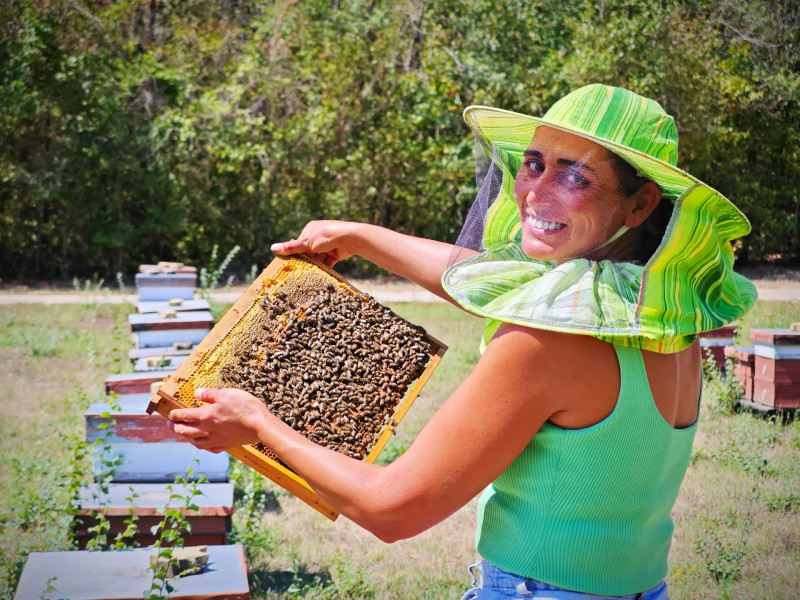
Photo: Jivko Konstantinov
Voyvoda village, Shumen region. Early morning.
Honey is harvested early. It’s one of the first things Nadejda Ivanova learned about beekeeping, and one of the rules she never breaks.
Just after six in the morning, Voyvoda is still cool. The air smells of wet grass and forest. The bees are already active.
Nadejda opens the hive calmly, without sudden movements. In beekeeping, haste doesn’t help. The work follows a steady rhythm and demands attention. Over time, movements become precise and economical, designed to disturb the bees as little as possible.
Honey is taken out until late morning. After that, the sun grows stronger and conditions shift. This, too, is part of the practice: adjusting to the weather, the temperature, and the bees’ reactions.
Nadejda works, and Ivan is nearby. He doesn’t get in her way or hover around her. Each knows their place. Over the years, they’ve learned that working together doesn’t mean standing shoulder to shoulder all the time; it means knowing when to be there and when to give space.
Inside the hive, life is intense. If you don’t know what you’re looking at, it can seem like chaos. Nadejda sees something else. She sees order. She sees movement with purpose. Later, she will say this was the first thing that won her over—not the beauty, but the logic.
She was nineteen the first time she looked into a hive. Back then, she had no way of knowing that the moment would quietly rearrange her life: postponing a wedding, replacing a dress with beehives, setting her on a path many around her dismissed with a familiar verdict: That won’t work in Bulgaria.
Today, that choice tells a different story. It isn’t only that it can work when Nadejda sets her mind to something. It’s also that hundreds of people now make the journey to Voyvoda every year, some of them again and again, to experience what she and Ivan have built.
The path of a dream
The beginning was hard. Theory didn’t help much. There is an old saying in Bulgaria: a craft isn’t learned, it’s stolen. Nadejda understood quickly that it was true.
Grandfather Dinko, who showed them one of his hives, helped during the first year. He demonstrated but explained almost nothing. When they asked questions, he answered calmly: “You’ll understand when the time comes.”
And the time did come. Through mistakes. Through reading. Through watching, again and again. Nadejda read widely and thought for herself. She drew on Bulgarian tradition, but she also looked outward, learning from international practice. Gradually, her idea of the farm took shape.
She knew what she didn’t want. She didn’t want it to be closed. She wanted the doors open.
“I want anyone to be able to come in and see where honey comes from,” she says.
Ivan was with her throughout—quietly, without stepping forward, but decisively. “To succeed, you have to believe in yourself,” Nadejda says, “and you need one more person who believes in you.” For her, that person is Ivan.
Together, they made choices deliberately. Not out of habit. Not because someone expected them to. They chose what felt right for them.
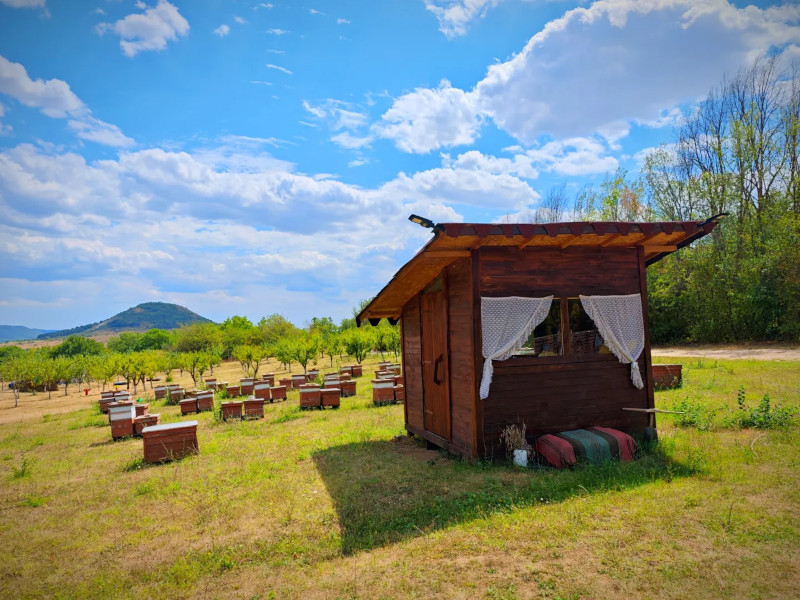
Voyvoda was familiar ground. Nadejda’s roots were here; Ivan’s parents lived here, too. But the farm didn’t come as an inheritance or a convenience. They bought a separate plot of land, chosen carefully. Not because it was “theirs,” but because it worked: forest nearby, rolling hills, space and forage for the bees.
They recognized the place by what remained untamed. By the sense that the land hadn’t been fully subdued. Much like the village itself once was, when the river ran stronger and its roar could be heard from afar—voy na voda, the roar of water, from which Voyvoda takes its name.
Here, the dream began to take on weight. Not as a plan on paper, but as work. Not all at once, and never easily. Step by step, the way any craft worth learning is mastered.
Some things don’t scale
There were years when Nadejda and Ivan lived entirely off honey. No guests, no experiences, no farm in the sense it has today. Just hives, long days of work, and the market in the nearby town of Novi Pazar.
That market mattered. It was where they met the first people who trusted them. They came early, asked few questions, bought honey, and returned the following week. Trust built slowly, jar by jar.
As demand grew, so did the farm. The number of hives increased; at one point, there were more than 230. There was plenty of honey, and plenty of work to match. Days filled with care, extraction, maintenance. Everything ran smoothly. And yet, something began to feel off.
The more hives they managed, the less time they had. Less time to observe the bees. Less time to talk to people. Less time to reflect on why they were doing this in the first place.
The shift in direction didn’t come as a single decision. It took shape over months, through exhaustion and long conversations. Nadejda and Ivan realized they didn’t want to chase customers or scale endlessly. They wanted people to come to them. Not only for honey, but for the place itself. For time spent among the hives, for a chance to understand the bees’ world.
They began by reducing the number of colonies. Fewer hives, more care. Less volume, more attention.
By then, the two of them had become four. First a son was born, then a daughter. And it was the children who gave the next nudge forward.
The first educational visit came with their son’s class, when he was in second grade. The children arrived, looked around, asked questions, laughed. Then another group followed. Then a third. The yard filled with noise, movement, curiosity.
Today, Nadejda and Ivan no longer think of people as visitors or customers. They welcome them as guests. There’s no tight schedule, no script to follow. Somewhere between the hives and the yard, short handwritten sentences begin to appear. Not signs. Reminders.
One of them reads simply: “Happiness is a choice.”
What happiness looks like
The farm today is many things at once. It is a home, a place for guests, and a working landscape. It resists being gathered under a single roof.
The buildings are spread out on purpose. The bedroom stands on its own. The living room is separate. The space for conversations has its own walls. Even the shared kitchen sits in a different structure. Life here doesn’t collect indoors; it unfolds outside. Nadejda puts it simply: the place needs to breathe. As does she. Once you’re here, the logic is immediate. You feel it in your body.
Around the hives, nothing ever really stops. The yard slips into the forest, the forest into the hills, and everything else arranges itself around that fact. There is a small area for tents and camper vans, two bungalows, and a yard where nothing is staged to impress.
The pool, built with the support of the America for Bulgaria Foundation, is part of the summer rhythm. Children move in and out of it. Adults sit nearby, talking or not talking at all. No one treats it as an attraction. It’s simply there, folded into the day.
One of the quieter places on the farm is the room with hive air. It’s tucked into the greenery, wooden and dim, with beds positioned above living hives. Inside, there are no instructions and no promises. You hear a steady hum. You smell wax, propolis, nectar. People lie down, breathe, and stay still for a while. Some fall asleep. Others just slow down.
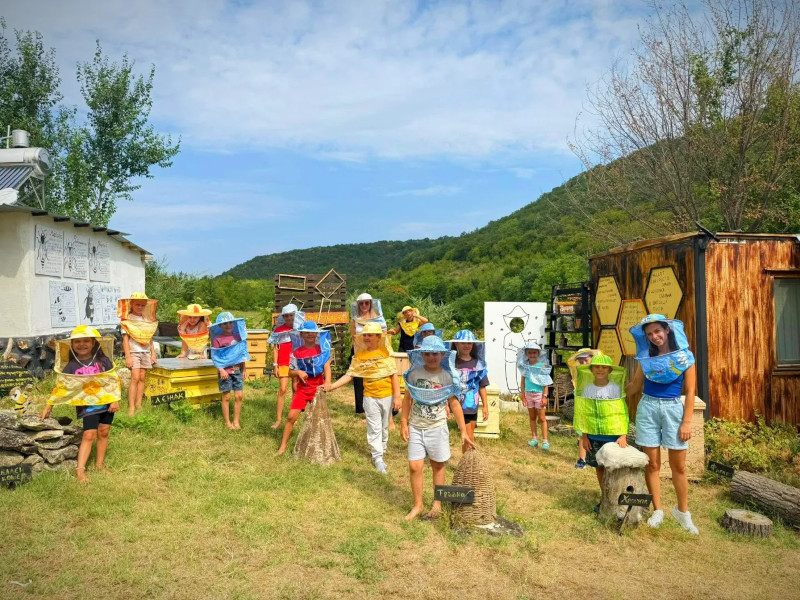
When children arrive, the rhythm shifts. They run barefoot. They pull on beekeeping suits. They watch honey being extracted, spin frames in the centrifuge, pour wax into small molds. It doesn’t feel like a lesson. It feels like being allowed to touch something real.
Meals draw people together. Everyone gathers around the shared table and eats what Nadejda has cooked: flatbreads, homemade lemonades, dishes that aren’t announced in advance and don’t arrive with explanations. They’re simply placed on the table when they’re ready.
In the evening, the fire burns slowly. Conversations stretch. At times, silence settles in. No one rushes to fill it.
Some visitors call the place magical. Others say only that they left feeling calmer. That they stayed longer than they meant to.
Sharing happiness
There is no Wi-Fi here. A handwritten note says it plainly: “No Wi-Fi. Talk to nature.”
No explanation is needed. Phones stay in pockets. The day fills with other things: walking, conversation, quiet.
Over time, Nadejda and Ivan began thinking about how to give their guests more room. Not more activities, but more freedom. They started marking paths. Not routes with signs and arrows, but trails you can take on your own: through the forest, across the hills, with the steady sense that you won’t get lost. You walk without a goal, but not without direction. You turn back when you feel like it.
Their plans for what comes next are modest. They’re building two more bungalows the way they’ve always built here—by themselves, with their own hands. Everything grows at the same pace. Carefully. Without haste.
Not because more isn’t possible, but because more doesn’t always add anything.
For Nadejda and Ivan, happiness isn’t expansion. It’s keeping what already works: time for people, space for silence, the freedom to be outside and not rush.
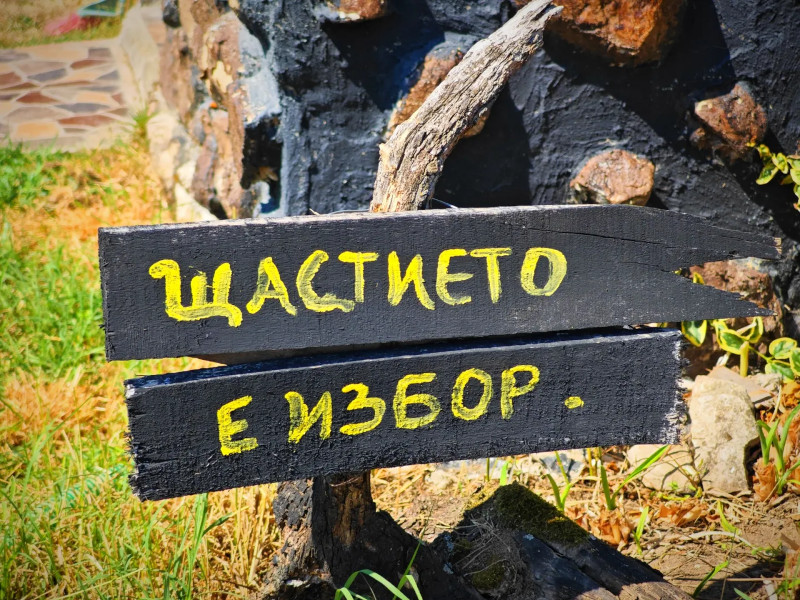
Photo: Jivko Konstantinov
Staying connected
Even now, when people come to them in Voyvoda, Nadejda still goes to the market in Novi Pazar. Almost every Friday. Not out of necessity, but out of loyalty—to the first people who believed in her.
Some of them are elderly and know her well; they’ve been buying her honey for nearly twenty-five years. It’s the kind of relationship you don’t step away from just because life has moved on.
These connections set the rhythm of the farm as much as the seasons do. In autumn, Nadejda brings together people from the village and nearby towns for a local feast. There’s no stage and no program. Just a reason to meet. The place opens in the same way whenever someone in the community needs support.
Nothing here is announced or put on display. Connections are kept quietly, through presence and return.
Last year, Nadejda finished writing a small book of fairy tales about bees—one for each month of the year. Short stories, each built around a different virtue. She didn’t write them as a beekeeper or as an author, but as someone sharing what she has learned along the way: calm, meaning, an appreciation for simple things.
“We can take a lot from the lives of bees and apply it to our own,” she says.
Nadejda often speaks about respect for bees. Over time, it becomes clear that this respect extends much further: to people, to labor, to time, and to the place where all of it unfolds.
The farm in Voyvoda isn’t a project, and it isn’t a tourist attraction. It’s built the way Nadejda and Ivan understand happiness—
with room for others in it.