Listen to this story on Spotify:
Boston, Massachusetts, 2024. Late evening.
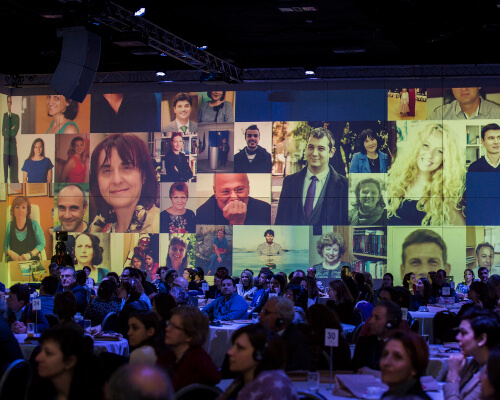
At LEAP, the days start early and end late. Lectures. Workshops. Meetings with entrepreneurs and community leaders. Conversations that spill long past dinner. By the end of the night, participants drag themselves back to their rooms clutching laptops, too exhausted to process everything they’ve heard.
For Mihail Milchev, that usually felt like the perfect moment to explore something else.
So, one evening, he headed to a fraternity party.
Mihail was part of the second cohort of LEAP, the America for Bulgaria Foundation’s three-week entrepreneurial leadership program run in partnership with Babson College. Despite the program’s demanding pace, Mihail somehow kept finding room for one more experience, one more conversation, one more detour.
He knew fraternity parties mostly from movies—loud college gatherings hosted by the all-male student societies that are a fixture of American campus culture. For most people in the group, they were just a quirky detail of college life. For Mihail, they were another piece of the America puzzle he didn’t want to miss.
“When else would I ever get to experience something like this?” he says with a grin.
A few days earlier, somewhere between sessions at Babson, he learned there was a regular microeconomics lecture happening nearby. It was not part of the program. Nobody expected him to attend.
He went anyway.
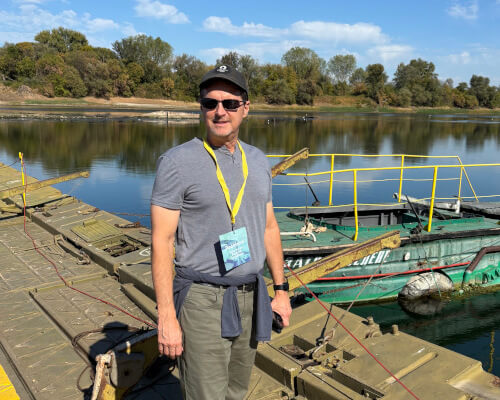
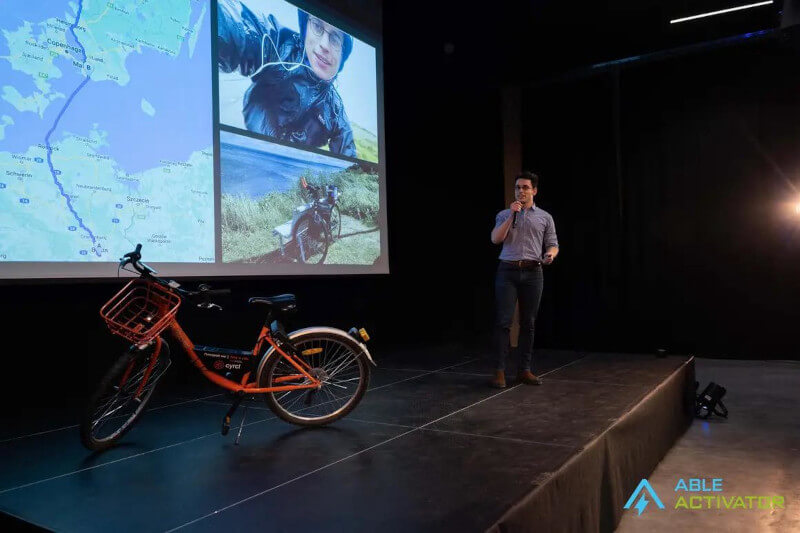
The next day, he and several other participants rented bikes and wove through Boston traffic using their phones as GPS, eventually reaching the campuses of MIT and Harvard. Mihail spent the ride photographing everything around him: building facades, strangers in the street, reflections in windows, accidental moments.
At a Boston market, he bought a souvenir: a baseball cap. But not just any baseball cap.
Instead of choosing a ready-made design, he sat down with the woman behind the counter, sketched out an idea with her, and watched as an embroidery machine stitched it into the fabric right in front of them.
That is exactly the sort of thing that draws him in—not just the object itself, but the process behind it.
Mihail rarely stays on the surface of things. He wants to understand how they work: cities, people, technologies, systems, ideas. How they connect. How entrepreneurship, design, and engineering can meet even in something as ordinary as a baseball cap.
Entrepreneurship in the DNA
Mihail’s fascination with how things are made did not come out of nowhere.
His family has always been full of people who work with their hands. His grandmother was a seamstress. His grandfather built theater sets. And after work, the two of them headed home for a second shift: raising chickens and selling eggs to the state.
In communist Bulgaria, where private enterprise was viewed with suspicion but shortages were everywhere, their small operation became a loophole in the system. At its peak in the 1980s, the family farm had close to 20,000 birds.
Years later, Mihail’s father carried that entrepreneurial instinct into a different era.
In the late 1990s, warehouses at a state-owned shirt factory in Vidin, a fading industrial city on Bulgaria’s Danube River, were overflowing with unsold inventory. Most people saw decline. Mihail’s father saw opportunity.
He bought shirts. Loaded them into a truck. Took them to Sofia’s wholesale markets. Sold them.
“No strategy. Just instinct,” Mihail says.
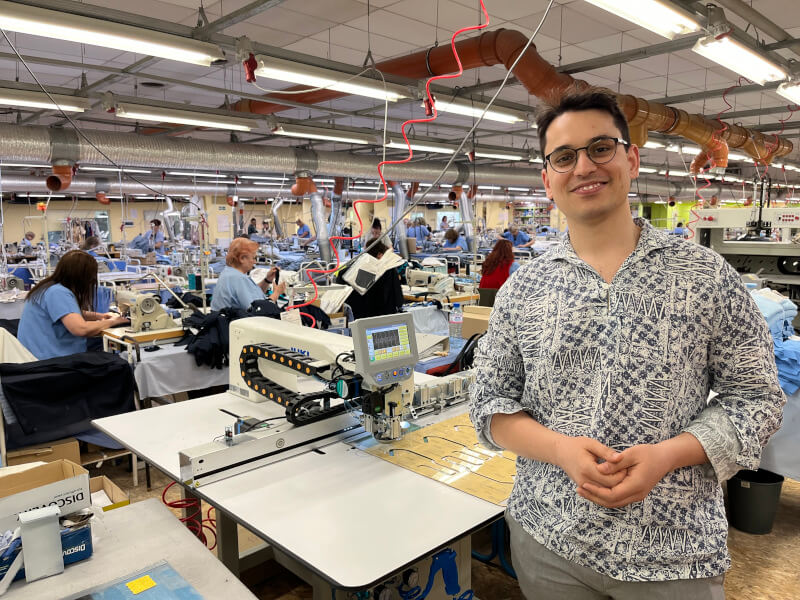
In 2003, his parents founded Bdintex, combining the old historical name of Vidin with the word “textile.” Two decades later, the company employs 170 people and works with major European clients, partnerships built through years of work, strict quality standards, and dozens of certifications.
“Entrepreneurship is in my blood,” Mihail says.
It is hard to argue with that.
The boy who ran the school bell
Maybe because he grew up around people who saw opportunities where others saw obstacles, Mihail developed an early habit of paying attention to places most people ignored.
Like the school radio room.
It was not the kind of room anyone imagined a future in. Dusty. Neglected. Filled with aging equipment that barely worked. The sort of forgotten space people walked past without noticing.
Mihail walked straight in.
“The first time we saw it, it was shocking,” he remembers. The only computer took forever to boot up, but the bigger problem was the broken audio mixer. They tried fixing the old one. It quickly became obvious that it was beyond saving.
So Mihail did something that would later feel completely natural to him.
He researched alternatives, narrowed them down to three models, and went to the principal to explain why the school needed one specific mixer.
“That was my first sales pitch,” he says, laughing—the first time he had to convince someone that his solution was the right one.
They got the mixer.
Slowly, the radio station came back to life. Instead of a standard school bell, music started echoing through the hallways between classes. Students gathered around the speakers during breaks. Eventually, Mihail became the DJ for school events—not because it had been some childhood dream, but because he was the only one who knew how everything connected.
Around the same time, in 11th grade, he and one of his best friends decided to build a circuit board.
Not for class. Not for a grade. Just to see if they could.
They found instructions online, figured out the process themselves, improvised with whatever materials they had. They transferred a schematic onto copper using an iron, soaked it in acid, soldered the components together.
The little car they powered could move forward and backward.
That was it.
“The fact that we found the information ourselves and actually made it work—that alone felt like an achievement,” Mihail says.
At the same time, he joined the school’s European club, traveled to the European Parliament, organized events, and became part of the student council.
He still had no idea what exactly he wanted to do with his life. But he was already developing the habit of trying things—and refusing to quit until he found a solution.
Starting from scratch, in German
After high school, Mihail moved to Germany convinced he knew what lay ahead.
The first few months humbled him quickly.
He woke up at 4:30 every morning to make deliveries. Then came German lessons. Then university lectures.
At the time, he was studying cybernetics in Stuttgart, but the pace was harder than he expected. Lectures moved fast. Technical terminology piled up. Sometimes most of his energy went into understanding the language itself rather than the concepts behind it.
He started falling behind.
Eventually, he made a difficult decision: start over. New city. New university. New field.
He moved to Berlin and switched to computer engineering. This time, things clicked.
He liked the immediacy of it: hardware, programming, systems that either worked or didn’t. Soon he was taking multiple exams at once, helping other students, and eventually graduating at the top of his class.
Then came bigger projects: obstacle-avoidance systems, autonomous vehicle technologies, an internship with a space-components company. Later, a role at Volvo in Sweden developing simulations for predictive truck maintenance.
University also opened the door to Asia. One semester in South Korea. Then an exchange program in Japan. Factory visits at Toyota and Honda. Meetings with engineers. Production floors where every movement seemed deliberate down to the smallest detail.
The experience deepened his interest in manufacturing.
“You realize the strongest economies are also strong industrial economies,” Mihail says.
Factories stopped looking like relics of the past. He began to see them as places where engineering ideas become tangible: machines, processes, products moving off the production line.
The more he traveled, the more often his thoughts drifted back to the family business in Vidin. To the factory. To manufacturing. To the generations of accumulated know-how that Bulgaria often overlooks in itself.
Around the same time, his sister joined Bdintex. Mihail began to picture his own place there—not simply as the son inheriting a family business, but as an engineer who could bring new technologies and new ways of thinking into the factory.
Meanwhile, he watched international companies invest in Bulgaria while startups like Dronamics—a Bulgarian cargo drone company—built globally ambitious products from the ground up.
Slowly, returning home stopped feeling like a compromise. It started looking like an opportunity.
“Vidin isn’t all that different from Berlin when you’re chasing a goal,” Mihail says.
Building the factory of the future
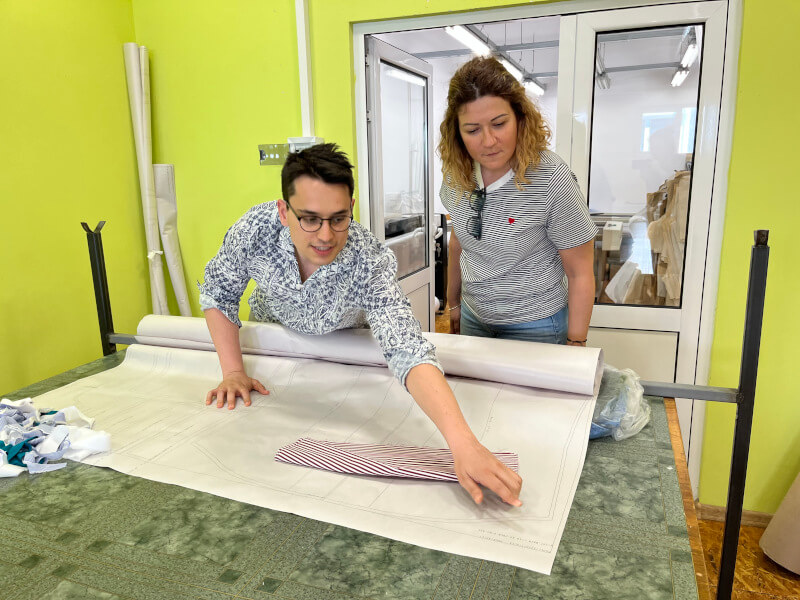
When Mihail returned to Vidin, he stepped back into a world he had known since childhood: the noise of sewing machines, rolls of fabric, delivery deadlines, trucks waiting for finished orders.
Bdintex works primarily with clients in Germany, Italy, the Netherlands, and soon the United Kingdom. The company manufactures shirts, uniforms, and workwear, an industry where mistakes cost time and delays cost trust.
Over the years, the factory has also become the largest private employer in the Vidin region, supporting dozens of local families.
But Mihail also knows something else: this model cannot rely forever on doing things the same way.
“The future, for me, is technical textiles,” he says. That means fabrics designed to do more than simply look good: flame-resistant materials, technology-integrated clothing, textiles built for function as much as comfort.
The shift has already begun. The factory is introducing new systems for production tracking and management. New materials require new machinery, new settings, new thinking. The shirts and uniforms are not disappearing; they remain the foundation. But on top of that foundation, Mihail is trying to build something else—manufacturing with higher added value and deeper technological integration.
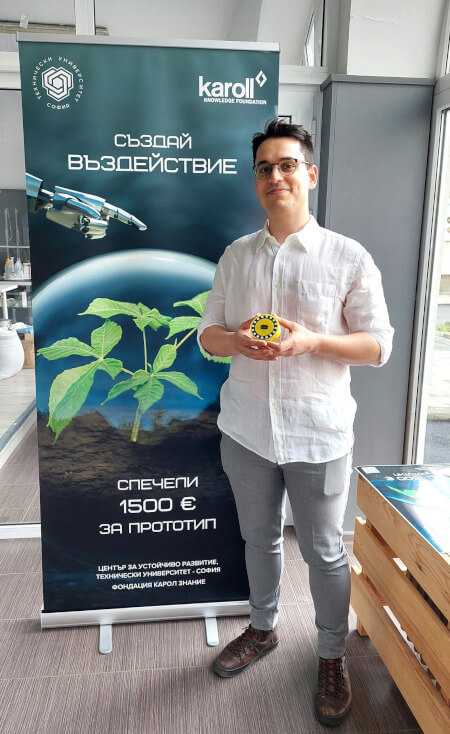
His PhD research at the Technical University of Sofia is part of the same pursuit. He is developing concepts for “smart” clothing capable of tracking biometric data such as heart rate and muscle activity. In 2026, the project received funding through the Create Impact competition organized by the Karoll Knowledge Foundation and the university.
It is still early. But for Mihail, the factory of the future no longer feels abstract—or far away from Vidin.
Don’t keep the craft to yourself
Even while studying in Germany, Mihail volunteered with CoderDojo, mentoring children learning to code.
Back in Vidin, he began working with students from a local vocational high school, helping with graduation projects, brainstorming ideas, and connecting them with people who could guide them further. One student developed a prototype for a professional property-management system. Another worked on ideas related to remote learning.
These are the moments Mihail seems to enjoy most: when someone is not yet sure they can build something but has already decided to try.
“The idea that you should keep your craft to yourself is outdated,” he says. To him, knowledge only matters if it is passed on.
After LEAP, he began thinking about collaboration even more intentionally—how people with different experiences can help one another instead of everyone reinventing everything from scratch.
That mindset has already led to unexpected partnerships. Together with another LEAP participant, Mihail organized a donation of fabrics from Bdintex, later turned into handmade products sold for charity.
Sometimes help looks small: a useful contact, a quick piece of advice, a few rolls of fabric, a conversation that saves someone weeks of trial and error.
For Mihail, though, this is not charity. It is simply how progress works.
Instead of an ending
Maybe one day, somewhere in the United States, a college athlete from a fraternity house will cross a finish line wearing gear made in Vidin. Or a firefighter will walk safely out of a burning building because of protective clothing manufactured there.
Most people will never know the story behind the fabric, the stitching, or the people who transformed them into something far more sophisticated than ordinary textiles.
But somewhere between the factory floor, the engineering ideas, decades of accumulated skill, and the curiosity of a boy who once walked into a dusty school radio room, that story is already writing itself.