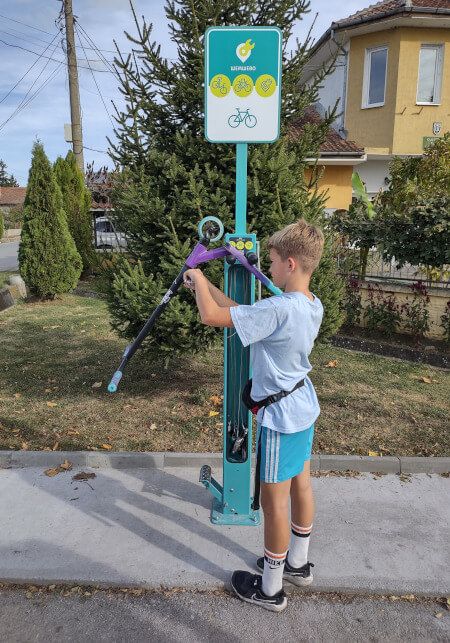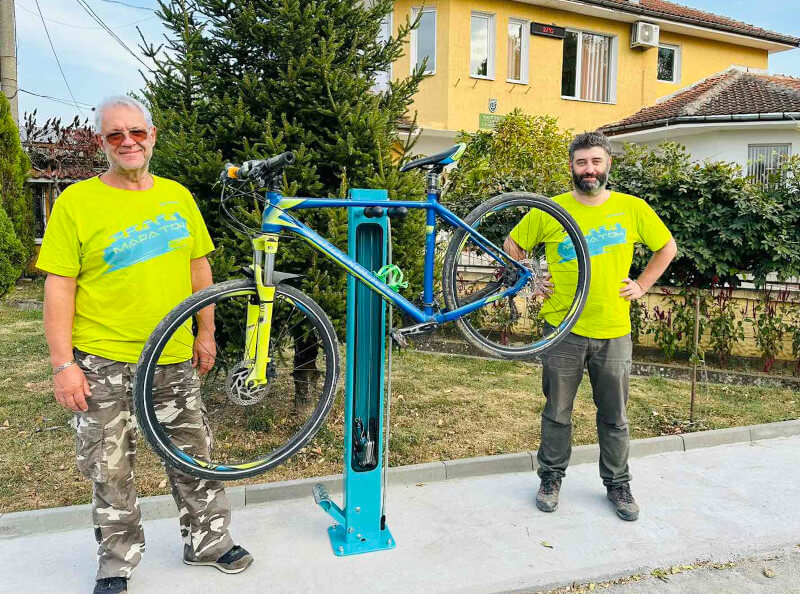
At first glance, they look like simple metal structures by the roadside. But for cyclists along Dunav Ultra, they are small islands of safety—stations equipped with pumps and tools that give riders the confidence to keep going, no matter what happens. Small gestures of care that turn a breakdown into a brief pause, not the end of an adventure.
The repair stations may look simple, but building them is anything but. It takes the mind of an engineer who thinks about durability and the hands of a mechanic who knows what tends to fail after hundreds of kilometers on dusty roads. You need the eye of a designer to make the stations intuitive and easy to use and the skill of a connector who can bring partners and supporters together.
And, of course, it also takes a dash of dreamer’s spirit. Because it takes faith to believe that people would cherish and care for something built for everyone.
This is the story of Zdravko Vasilev from Varna—an engineer by training, a bike mechanic by trade, and a community builder at heart. He likes to joke that he’s “all over the place,” but it’s precisely this mix of interests and skills that helped him create Bulgaria’s first public bicycle repair stations. Ten of them now stand at key points along Dunav Ultra, the country’s longest and best-known cycling route, attracting adventurers from all over the world.
First love never fades
Bicycles have been part of Zdravko’s life for as long as he can remember. In the family archive, there’s a black-and-white photo of his first tricycle, taken when he was just a toddler. The second one he remembers vividly: those summers with his grandparents in Gabrovo, flying down a hill, the first “crash” into a parked Moskvich and the owner’s wide-eyed shock. “I was so embarrassed, but I just loved going downhill,” Zdravko says, laughing.
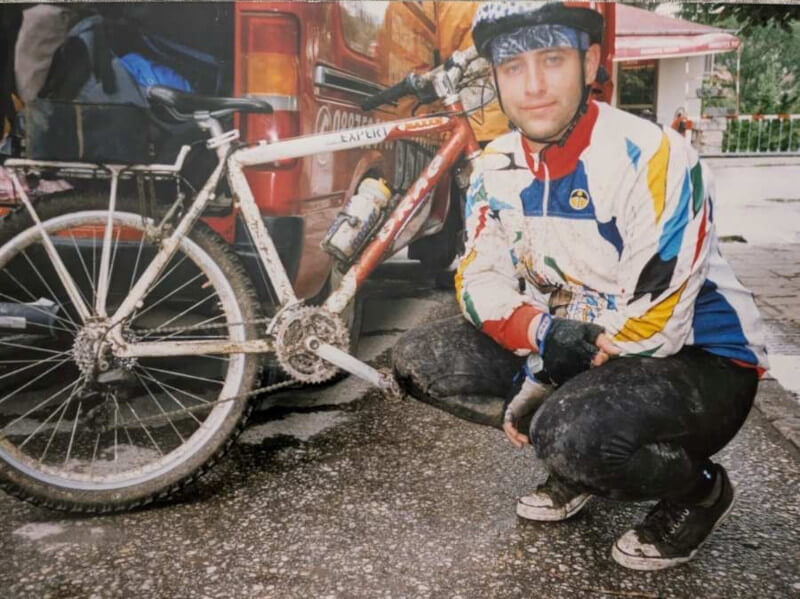
The best surprise of his childhood came in first grade—a brand-new Balkan bicycle waiting by the door. That’s when he learned to balance on two wheels, collected his share of scraped knees, and made new friends. Later came his first gear bike, and by the late 1990s his father bought him and his brother their first mountain bikes. Those rides beyond the city limits were exhausting but thrilling; they opened up a new world.
By the early 2000s, Zdravko was no longer just riding—he was organizing friends for longer trips. What started as a school hobby gradually grew into a community. “Bicycles have always been part of my life and a part of me,” he says today.
A family tradition
Zdravko didn’t just inherit a love of bikes; he inherited a legacy of active, creative people who made a difference in their communities. His father was an assistant stage director at the Varna Opera—the person behind the scenes who keeps the entire production running. His mother danced with the Golden Sands folk ensemble, one of Varna’s cultural emblems. His grandfather was a music teacher, choir conductor, and civic leader who founded numerous choirs and cultural events. Further back, his great-grandmother was a teacher, and his great-grandfather—a scholarship recipient of Bulgarian Enlightenment figure Vasil Aprilov—earning a degree in mathematics in Odessa in 1919, at a time when few Bulgarians had access to secondary education.
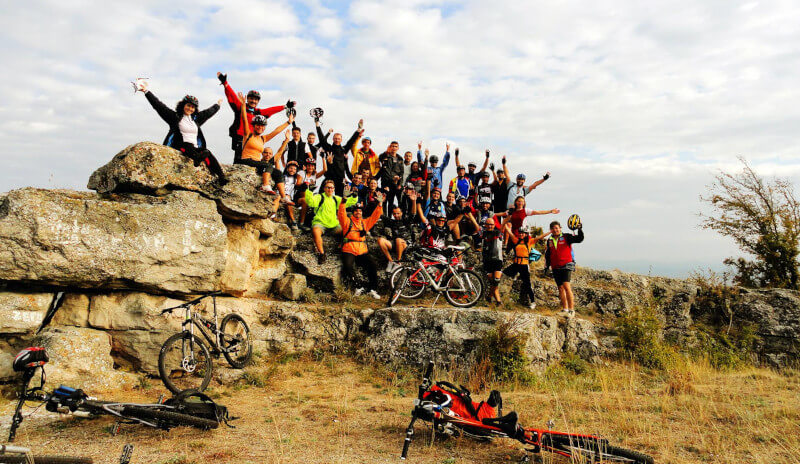
Growing up in this family of artists, educators, and community leaders, Zdravko absorbed the idea that being active and creative is a way of life. Choosing a “safe” major—Computer Systems and Technologies at the Technical University of Varna—seemed like a brief detour. “I was set on becoming a network specialist,” he recalls. But while his classmates chased IT careers, Zdravko realized his path lay elsewhere. He continued his family’s tradition of public service, blending his love for bicycles with work that benefits others.
Driven to make a difference
In 2003, Zdravko started gathering friends for bike rides. What began as casual outings soon turned into something bigger, a community. That’s how Ustrem (“Driven”) was born, first as an informal group within a local tourism society and, by 2008, as a registered NGO. “At that time, there wasn’t an organization in our city that united cyclists, organized events, and worked for better conditions for biking. That became our mission,” says Zdravko.
Over the years, Ustrem’s activities multiplied: rides, marathons, races, festivals, clean-up campaigns, charity events, and training sessions. They founded a plastic recycling workshop called Green Motives at the Technical University of Varna, and Zdravko played an active role in the city’s successful bid for the title European Youth Capital in 2017.
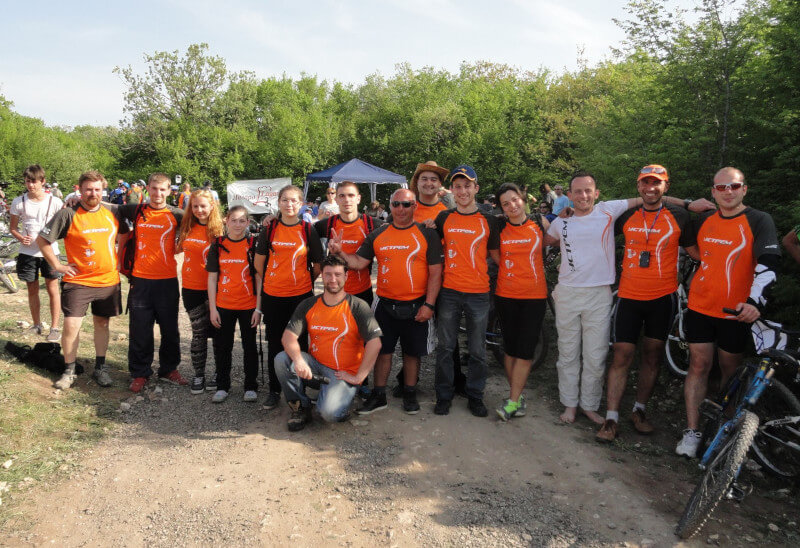
On the national level, Ustrem contributed to Bulgaria’s first National Cycling Plan and the creation of the official standard for cycling route marking. One of the largest initiatives they supported was the Black Sea Route, a proposed coastal trail linking Constanța, in Romania, and Istanbul, in Turkey, along Bulgaria’s entire Black Sea coastline.
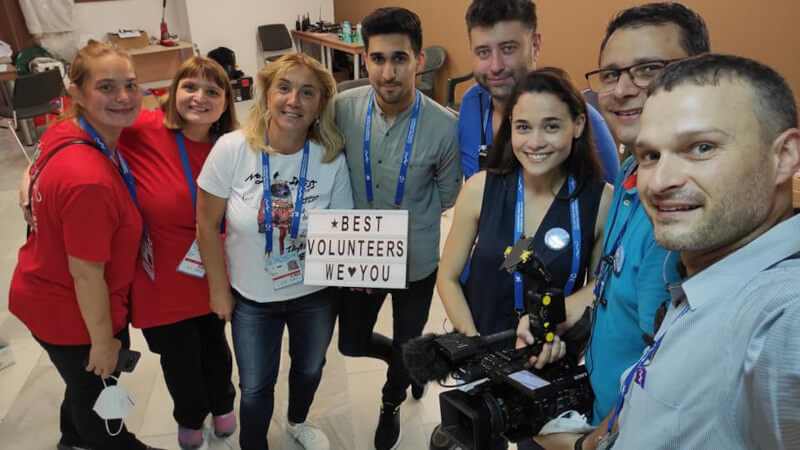
Along the way came Volunteers with Ustrem, one of the country’s biggest networks of young people helping at cultural and sporting events. “We provide volunteers, or ‘smart movers,’ as I like to call them,” Zdravko smiles.
The same community energy carried into his bike shop in Varna. It wasn’t just a place to buy parts; it became a gathering point where people repaired bikes, shared routes, and planned adventures together.
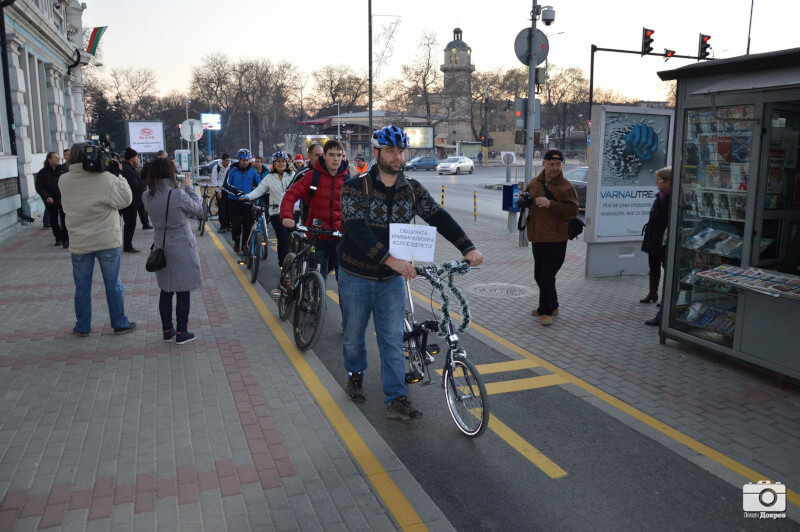
For Zdravko, the bicycle has never been just a means of transport. It is a way to bring people together, to share, to build something lasting. What began as a group of friends became one of Varna’s most active civic organizations—and a reminder that young people can shape their city for the better.
Stations with a Bulgarian touch
In 2020, Zdravko and his Ustrem colleague Boyko Stoyanov joined a project by the municipality of Byala to design two cycling routes. There they encountered a common problem for small towns: the lack of bike repair services. The idea of public repair stations wasn’t new; Zdravko had seen them abroad. But he wanted to make them better—stronger, more functional, and suited to local conditions.
“It started with the idea of creating Bulgarian repair stations that would outperform all others,” he recalls. Designing, prototyping, testing, and refining them took two years. His engineering background, his experience from Green Motives, and 14 years as a professional bike mechanic all played a part.
Today there are 27 stations across Bulgaria (follow the interactive map to find out their precise locations). Each combines a stand, a pump, and more than 25 tools, useful not only for bicycles but also for scooters, wheelchairs, and skateboards. Most importantly, people use them—and take care of them. “A year after the first installation, not one has been stolen, broken, or vandalized,” Zdravko says proudly.
The biggest challenge came with Dunav Ultra, a 740-kilometer (460-mile) route stretching from Vidin to Durankulak along the Danube River. Ten of the stations are now located there, installed with the support of the America for Bulgaria Foundation. The process wasn’t without challenges—sometimes foundations had to be rebuilt or permits took time—but perseverance paid off. Today, these stations have become a trusted lifeline for everyone cycling along Bulgaria’s most iconic long-distance route.
The joy that keeps him moving forward
In Zdravko’s world, what looks like chaos is really the order of someone who cares deeply—for people, for his city, for those who set out on the road. Engineer, mechanic, organizer, and volunteer all in one, he has found a way to turn his many skills into something meaningful for others.
Balancing so many projects isn’t easy, but the results speak for themselves. Varna’s cycling community is stronger than ever, young people are finding new ways to get involved, and the repair stations give travelers the confidence to keep going. “When you see the results and the joy in people’s eyes, the tiredness disappears,” Zdravko says.
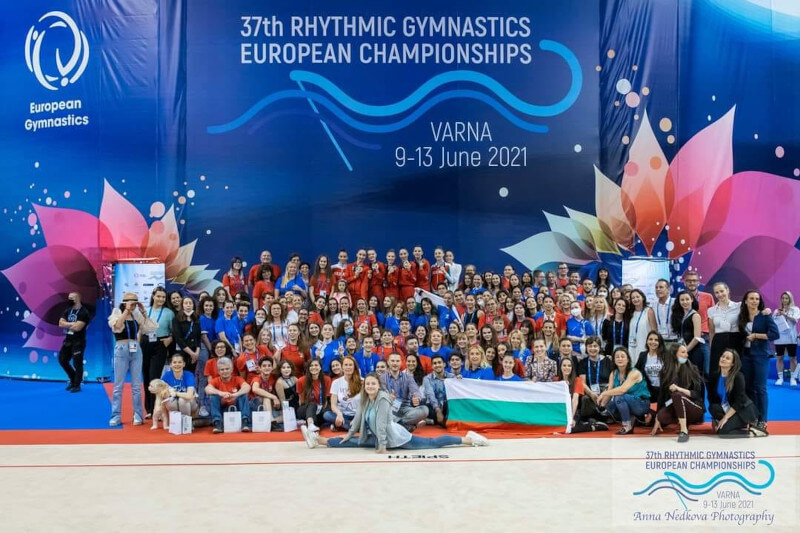
That joy is what drives him forward, not the applause, but the sense that his work matters. For Zdravko, true fulfillment comes in small moments: when a traveler continues their journey thanks to a timely repair, when a young person finds purpose in helping, when the city comes alive through collective effort.
And, as always, the next challenge is already on the horizon. By the end of the year, five new repair stations will be installed at mountain lodges across Bulgaria with the support of Bulgarian tech company SiteGround. With that, even more trails in the mountains will become safer, more welcoming places for everyone who sets out to explore.