They build rockets in their spare time. They solve physics problems for fun. They watch Star Wars and keep a running list of the science goofs. Instead of the beach, they spend summers in courses and workshops; on social media they follow scientists and founders, not influencers and pop stars.
These are tomorrow’s discoverers, Nobel laureates, and space entrepreneurs. And they’re exactly the kind of people who gather for the five-week Space Challenges program run by the Bulgarian satellite company EnduroSat.
This year, 45 participants from 14 countries met in Sofia—ranging from high-schoolers to PhD candidates. Many are top of their class at places like Imperial College London, Delft University of Technology, Technical University of Berlin, the Institute of Aeronautical Engineering at the University of Toulouse, and the University of Naples “Federico II.” They come from countries with mature space industries, yet choose to gain hands-on experience in Bulgaria—working shoulder to shoulder with EnduroSat teams and getting direct access to lecturers from NASA, the European Space Agency, and other leading organizations.
A day in the Space Challenges program
Each day opens with big ideas that, elsewhere, live as formulas in textbooks—but here they come alive, told in the first person. Today, might be orbital mechanics—how bodies move in space and how we control that motion in practice; tomorrow, it could be space law and the space economy—who gets to launch what, how orbits are shared, how missions are financed, and what a “space market” really means. Challenging, yes, but rooted in real missions by practitioners, with questions addressed in the moment, while curiosity is still buzzing.
The lecturers this year are the kind you rarely meet up close, let alone all in one room. Dr. S. Pete Worden, former director of NASA’s Ames Research Center, explains why major breakthroughs often start with small, bold teams—and then sticks around after the talk to sketch through students’ experiment ideas. Jan Wörner, former director general of the European Space Agency, takes you behind the scenes of European missions—how decisions are made, where mistakes creep in, and how course corrections happen—inviting participants to ask away.
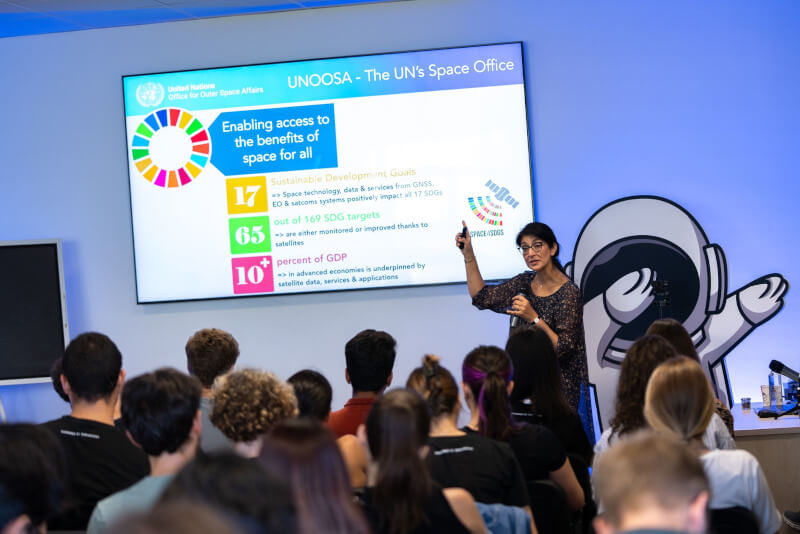
A leader from US company Planet Labs shows how a fleet of small satellites images the entire Earth every day and how that steady stream of pictures powers agriculture, insurance, and disaster response. EnduroSat engineers, meanwhile, demonstrate how a rough sketch becomes a prototype and how a prototype becomes a system that actually flies. The conversations run long after the lectures end.
The day’s high point is the work on the “space challenges”—real problems that teams must turn into working prototypes in five weeks. One team builds a system that turns raw satellite images into timely alerts for farmers: “The northeast corner of the field is lagging. Check your irrigation.” Another designs methods for more reliable detection of ships in open waters. A third trains models for early wildfire prediction. These aren’t classroom drills; they are first versions of solutions with direct value for farmers, coast guards, and emergency responders.
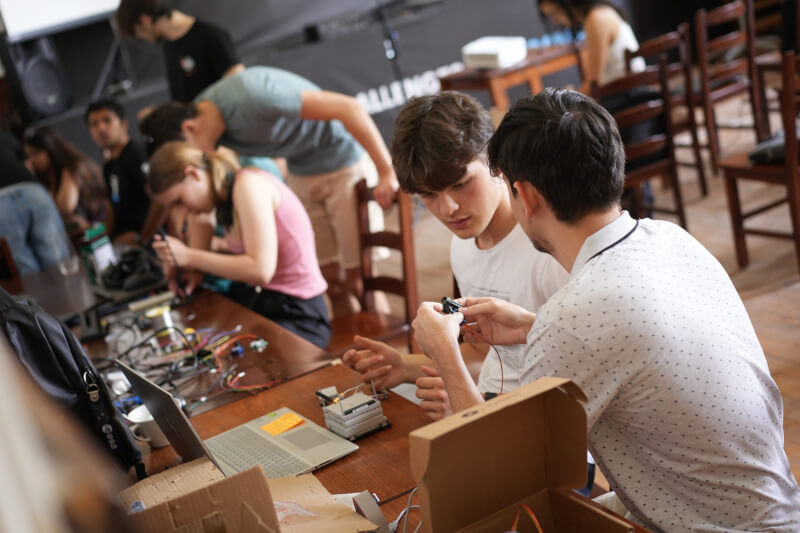
Because the problems are complex and rarely have perfect answers, the teams are mixed by design. A group might include a student from Costa Rica, a master’s candidate from India, and a high-schooler from Switzerland, alongside participants from Bulgaria, Italy, or Kenya. One is strong in math, another in coding, a third in process and clear storytelling. That deliberate mix is what sparks solutions: perspectives cross, ideas stack, and, by day’s end, there’s that quiet “aha!”—progress you can point to.
An environment that accelerates talent
One of Space Challenges’ big lessons: solo effort moves you forward, but it hits a ceiling fast. Filip Andonov, a third-year student at the Technical University of Sofia, knows this first-hand. He finished school with distinction and a shelf of olympiad awards—and the feeling that, alone, you run out of runway. “We have great people in Bulgaria, but we lack the environment,” he says.
Last summer, he joined Space Challenges and found exactly that—so this year he returned as a mentor. After the program, he also founded an engineering club with like-minded peers who dream of building a working rocket. Filip thinks like an entrepreneur, and space is the natural terrain for that mindset: “In space, everything starts from zero.” Here, that zero isn’t scary: it’s a starting line.
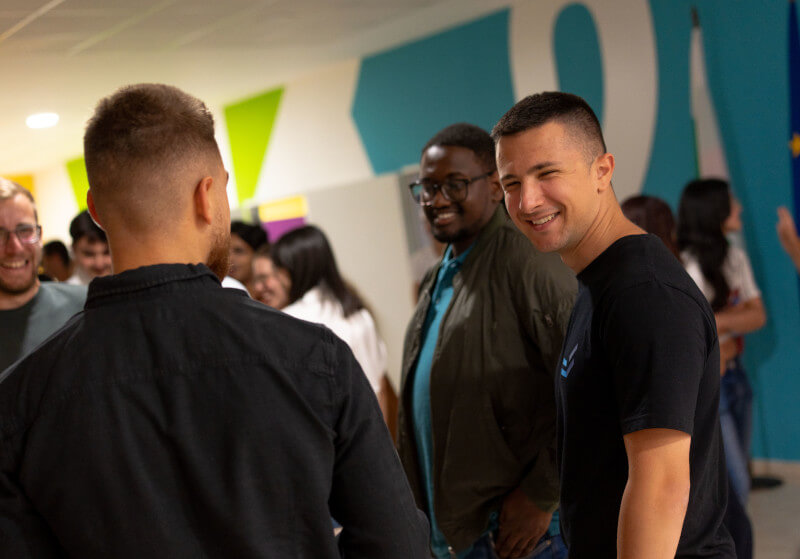
Mentors think the same way. “They shouldn’t be afraid to fail. Not everyone ends up with a working prototype, or completes their work at 100%, but here you find those who aren’t quitters. That’s how innovation happens,” says Krasimir Stoev, senior AI developer at EnduroSat and a mentor in the program. In a team, mistakes become shared experience, and finishing the job becomes a habit.
From curiosity to use
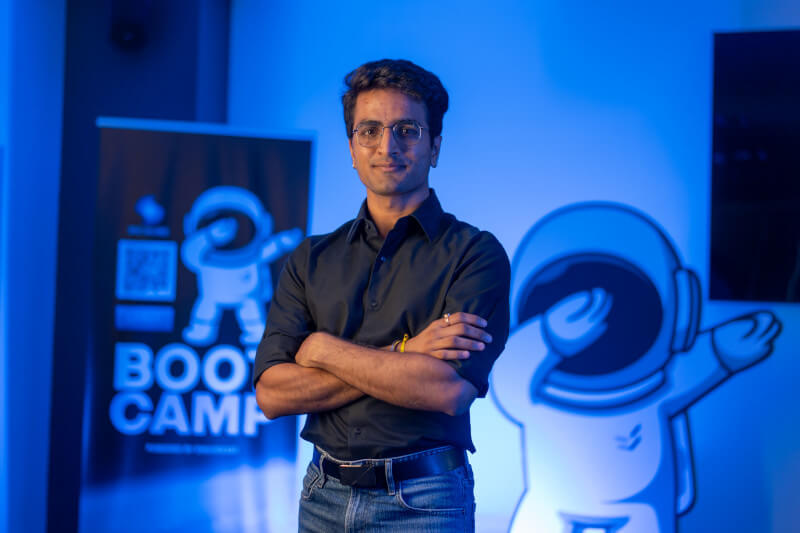
Kiiran Jadhav came from India to study aerospace engineering at TU Delft. He’s chased questions about black holes and orbits since childhood; now he explains his team’s project so simply anyone can grasp it: “If you’re lost in space, how do you know where you are? Just like sailors use the North Star, we’re building a system so satellites can use all the stars for guidance.”
He’s also the one who pauses movies to fact-check them—Interstellar is, in his view, the rare film that earns an “excellent” for scientific accuracy. That knack for translation is part of what the program cultivates: turning hard problems into clear stories with measurable value.
The same arc—from “I want to know” to “here’s how it helps”—is true for Alexandra Kobakova. She comes from the American College of Sofia with the confidence of someone who aced math and robotics competitions—and the perfectly normal worry about keeping up with older, more seasoned teammates. “At first, I hesitated. Then the pace just carries you, and suddenly you’re doing things you didn’t think you could a month ago,” she says. Her team built a model that uses satellite data to track soil health—information a farmer, local government, or an insurance company can act on.
This year Alexandra is back at Space Challenges as a volunteer; in the fall, she’s off to Delft to study aerospace engineering. Two different routes, same result: curiosity translated into practice, with entire industries benefiting.
From London and Geneva to Sofia
At 19, Londoner Mubasshirah Khan is already on an impressive track: a first-year aeronautical engineering student at Imperial College London, deep into coding and aerodynamics, with a long-term goal of working at NASA. Her parents have always cheered her on with a smile: “It’s not rocket science,” meaning, You’ve got this. Mubasshirah would laugh and answer, “But rocket science is exactly what I want to do.”
She learned about Space Challenges from a professor’s email and came to Bulgaria for the first time (yes, she looked it up on the map—then booked the ticket). The rhythm suits her: big ideas, work with mentors, hands-on sessions. “Space Challenges was exactly what I needed—where in such a short time, we’re exposed to so many things, from orbital simulation to hands-on hardware,” she says.
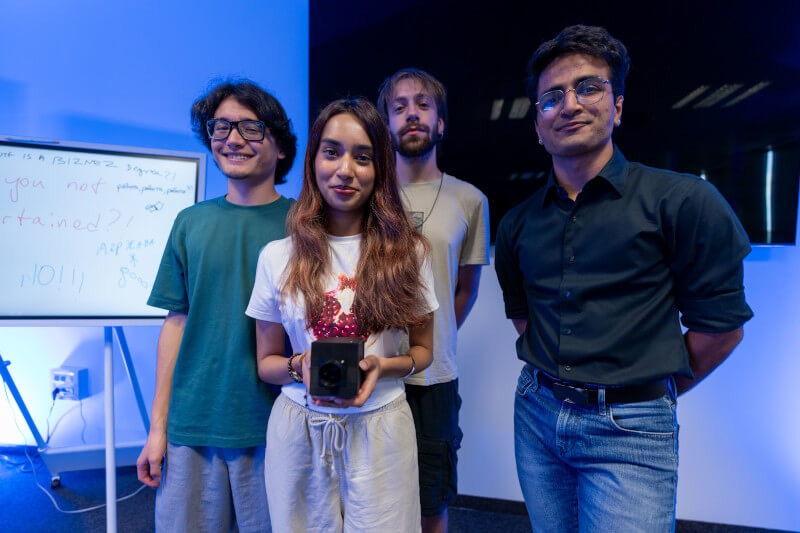
Seventeen-year-old Victoria Hristova thrives in the same rhythm. Born in Bulgaria and raised in Switzerland since age four, she’s been drawn to astronomy and physics for as long as she can remember. Opportunities aren’t scarce where she lives, yet the programs that fit her best, she found in Bulgaria. Still in high school, she takes remote courses in theoretical physics and advanced math at Sofia University and attends after-school programs taught by renowned physics teacher Teodosiy Teodosiev. “I was surprised Bulgaria has such serious opportunities,” she says.
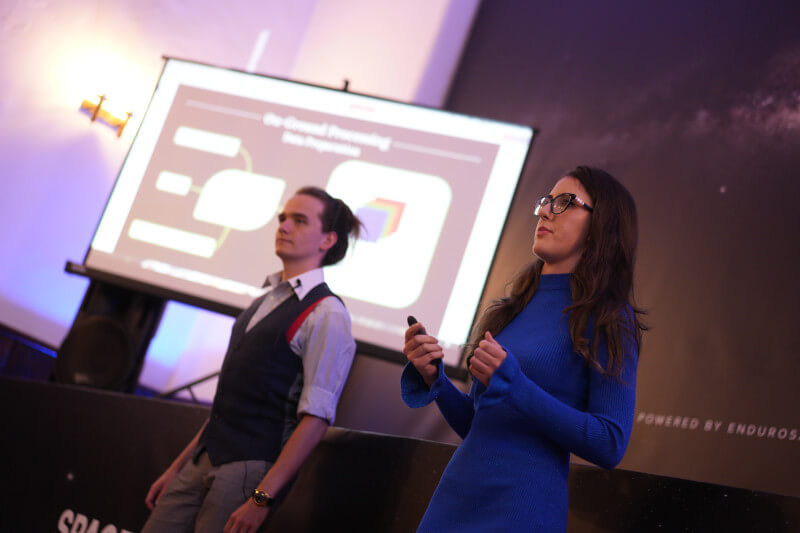
Victoria is part of a five-person team tasked with tracking a moving satellite with no prior data and predicting its orbit using sensors and mathematical modeling. She naturally takes on the heavy math—the orbital dynamics. “We all have strengths and weaknesses, but we cover for one another. I did all the math and orbital dynamics; a teammate is strong in software, so we trade knowledge,” she says.
Mubasshirah, meanwhile, is working on a star tracker—a satellite’s sky compass that matches star images to catalogs to tell it which way it’s pointing. Both teams move in short loops: calculate, try, check. They note what worked, fix what didn’t, and push to the next iteration. Bit by bit, the complicated becomes a clear checklist for tomorrow’s test.
Small country, wide horizons
There are moments in that rhythm when you forget where you are. After another round of measurements and calculations, you step outside for air, see the tram rattle by, the busy boulevard, the Sofia sky—and think: right, this is Sofia.
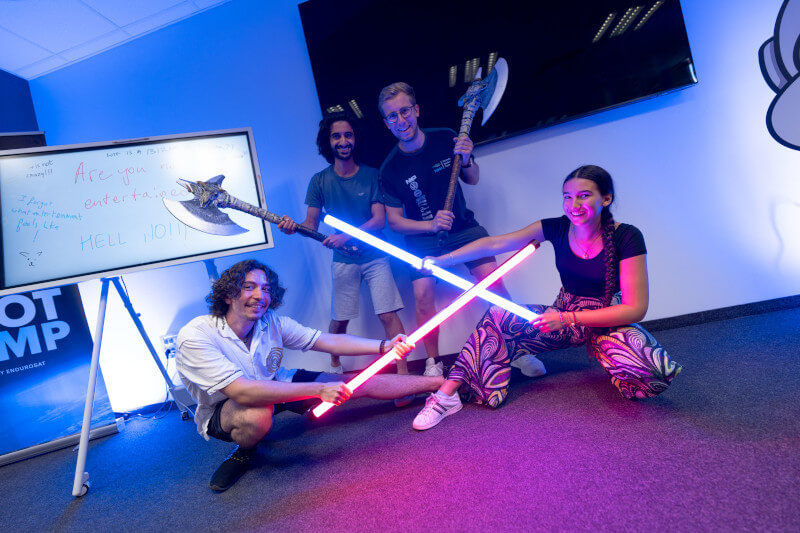
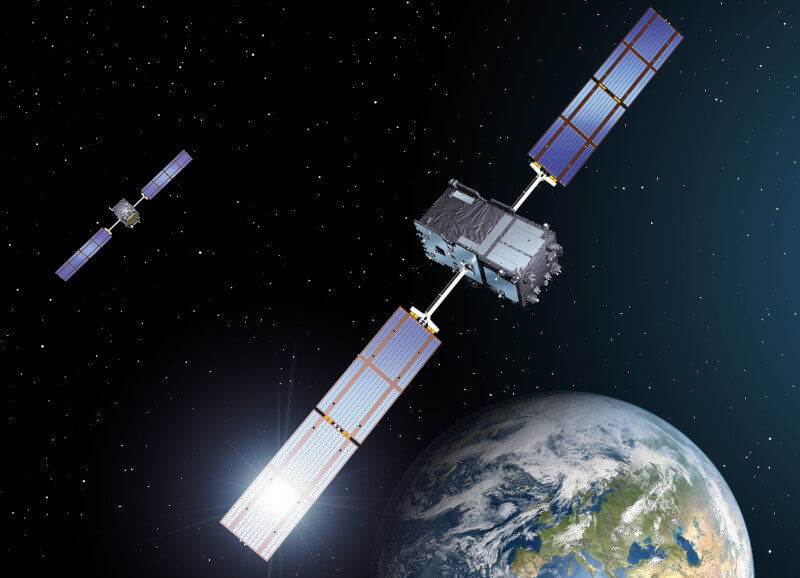
Bulgaria may be small, but its space story is long. In 1979, it became the sixth nation to send a person into orbit; in 1981, it launched its first satellite. Bulgarian research teams have developed food for astronauts for decades, and Bulgarian companies have turned it into a business. Today EnduroSat designs, builds, and operates satellites for clients around the world.
Space Challenges is a natural extension of that arc—an intensive program where international teams learn by doing and turn science into solutions with real-world value.
Launched in 2010 as a lecture series at Sofia University, the program now runs like a mini master’s program: five weeks of focused, cross-disciplinary learning—from astronomy and engineering to space law and the space economy—paired with extensive hands-on work under the guidance of leading scientists and industry practitioners. It’s not a course you sit through; it’s a place where ideas get tried, refined, and turned into prototypes.
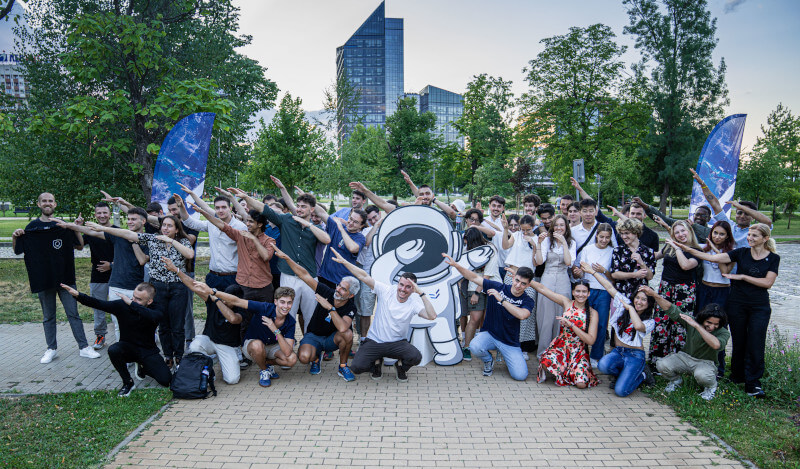
Participation is free—students cover only their travel to Sofia—but they’re expected to bring their best. Over 15 years, the program has accelerated more than 600 young people from 25 countries. Many go on to top universities and innovative companies; more importantly, they leave with the ability to turn complex theory into practical results.
This philosophy is clearest in the words of Space Challenges founder and EnduroSat CEO Raycho Raychev: “Space education should be fundamentally accessible and relevant with the latest trends in the space industry. We believe that it’s only through practice and overcoming the fear of failing that you can master fundamental principles and develop your skills.”
Here, that’s not a slogan: it’s the daily routine.
Instead of a conclusion
Participants in the program are called “space cadets”—as if they’re about to zip up their spacesuits and board the next shuttle to new discoveries. Five weeks won’t conquer space, of course, but they’re enough to find a trajectory. And they show that when talent, courage, and the right environment come together in one place, the winners aren’t just one person or company—it’s all of humankind.
The America for Bulgaria Foundation supports Bulgarian science by backing programs like Space Challenges.